



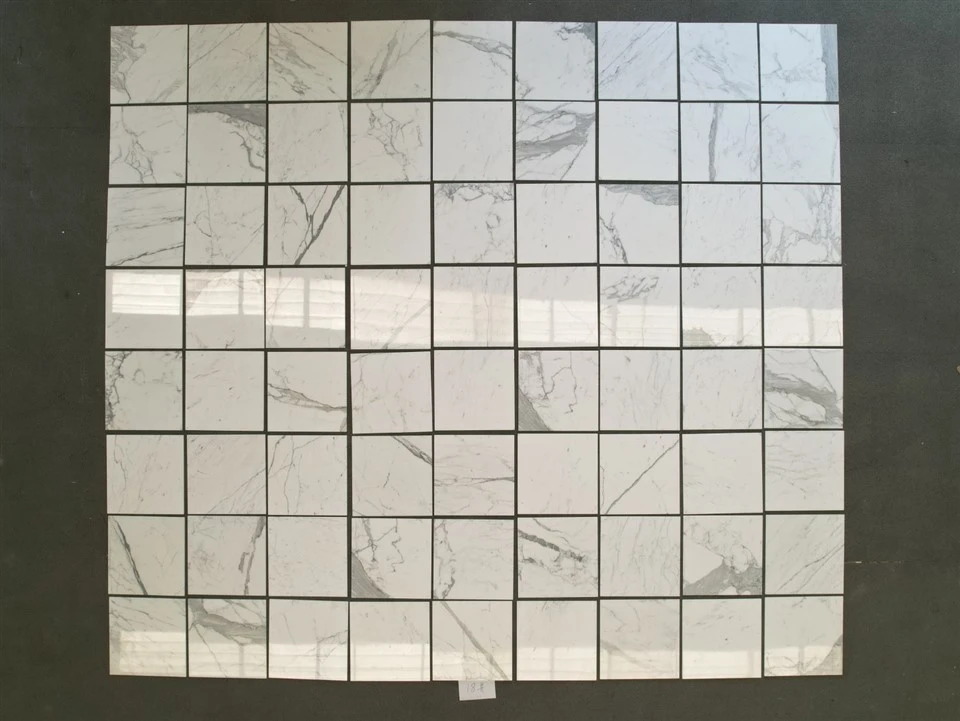

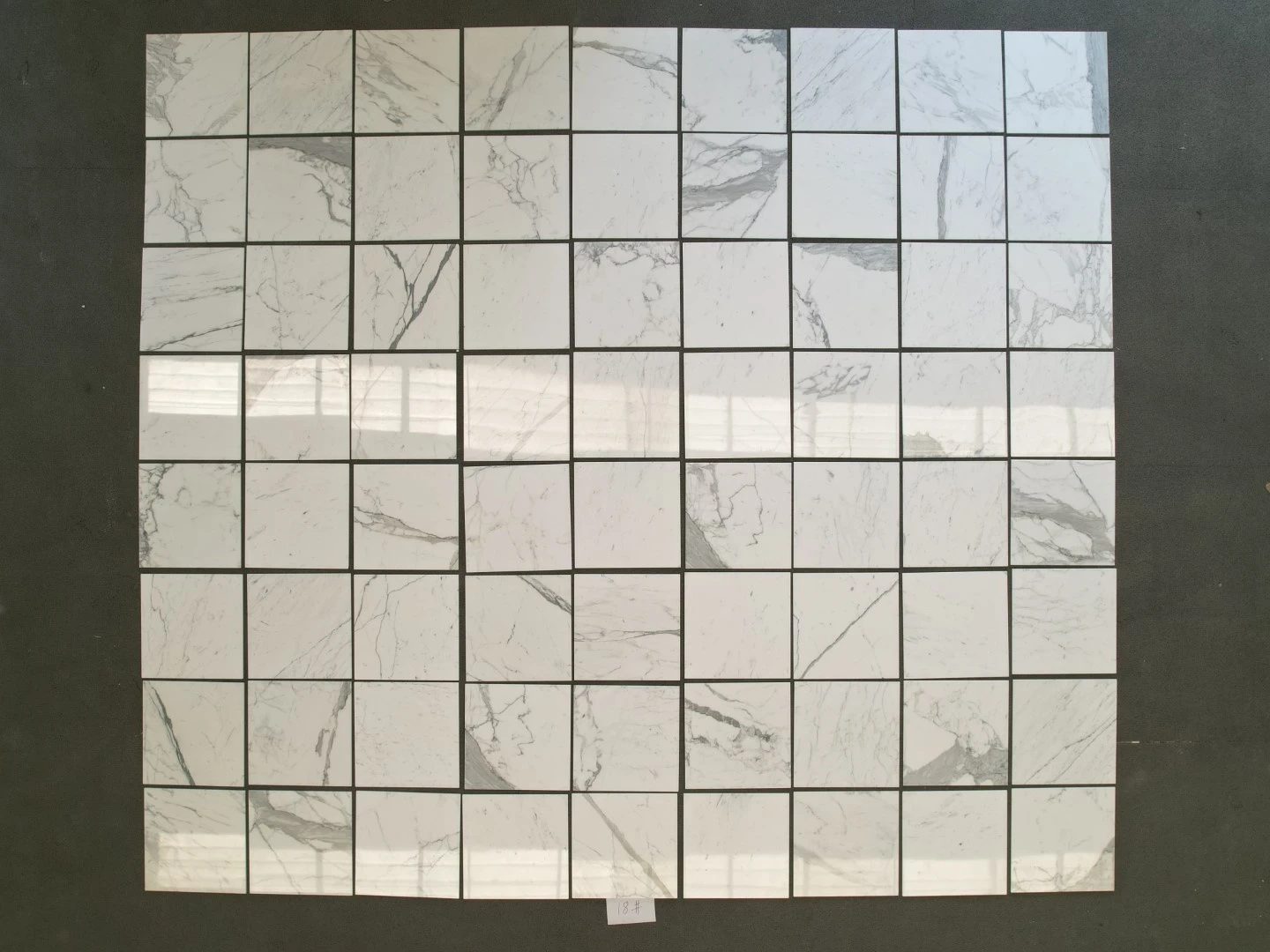
Factory dry layout inspection of polished Calacatta marble floor tiles before numbering and packing.

Polished Calacatta marble floor tiles arranged in a random-vein factory dry layout for quality inspection, position adjustment and installation numbering.

Close-up of polished Calacatta marble tiles arranged in a random-vein dry layout.

Calacatta marble floor tiles protected in custom foam inner boxes before export crating.

Calacatta marble tiles packed in a reinforced solid-wood export crate with straps and waterproof wrapping film.
Italian Calacatta Marble Tiles
- Fast Delievery
- Quality Assurance
- 24/7 Customer Service
Executive Summary
For this order, random-vein installation was a deliberate cost-control strategy for premium Calacatta marble. The approach uses small polished tiles efficiently while factory dry layout, inspection, numbering, and direction marking help align the approved tile arrangement with the expected installed appearance.
The order called for 12 x 12 in (305 x 305 mm) Calacatta marble floor tiles cut from 18 mm slabs and finished with a polished surface. A random-vein composition does not attempt to maintain a continuous vein across every joint. Instead, balanced color distribution, varied veining, and the avoidance of visually disruptive clusters are reviewed across the full layout.
Key Facts
| Specification Item | Order Detail |
| Product | Natural Calacatta marble floor tiles |
| Tile size | 12 x 12 in / 305 x 305 mm |
| Thickness | 18 mm, cut from 18 mm Calacatta marble slabs |
| Finish | Polished |
| Intended visual arrangement | Random-vein installation rather than continuous vein matching |
| Cost-control logic | Small-format random-vein cutting can improve use of expensive Calacatta slab material because pieces are not locked to one continuous vein map |
| Factory appearance control | Full dry layout, quality screening, position adjustment, unique numbering, and installation-direction marking |
| Surface protection | Water-based protective sealer applied to accepted finished tiles; exact product and application must follow the manufacturer's instructions and project requirements |
| Inner packing | Custom foam boxes for separation, cushioning, and edge protection |
| Outer packing | Reinforced solid-wood crate, external straps, and waterproof wrapping film; destination phytosanitary requirements must be confirmed |
Why Use a Random-Vein Layout for Calacatta Marble Tiles?
A well-controlled random-vein layout can reduce material consumption for expensive Calacatta marble because each small tile does not have to follow a fixed continuous vein sequence. The visual result still depends on disciplined factory sorting and dry layout rather than uncontrolled mixing.
Continuous vein matching can require reserving large slab areas and rejecting otherwise usable regions when the pattern must flow through predetermined joints. For this 305 x 305 mm order, the buyer requested a deliberately random installation. This allowed Landiview Stone to cut suitable areas from existing Calacatta slabs, subject to current material availability and agreed appearance criteria.
Random does not mean unreviewed. Strong-veined, light, and quieter tiles must be distributed so that one area does not become visually heavy while another appears empty. Final acceptance should be based on the actual dry layout rather than a small sample alone.
Why This Order Did Not Require Shop Drawings or Slab-Scan Layout
Project tiles normally benefit from stone shop drawings, actual slab approval, and scan-based AutoCAD cutting simulation when piece locations, dimensions, joints, or vein relationships are predetermined. Landiview Stone uses those controls when the architectural intent requires them.
For this order, every tile had the same small format and the intended appearance was random-vein installation. There was no fixed room-by-room vein map or continuous book-matched composition to approve before cutting. Suitable existing slab stock could therefore be cut directly into 12 x 12 in tiles, followed by physical dry layout of the finished pieces.
This simplified route is project-specific. Shop drawings, slab approval, and digital layout should not be omitted when field dimensions, borders, cut pieces, transitions, openings, directional veining, or numbered room layouts must be coordinated.
Factory Production and Quality-Control Workflow
1. Confirm the required 12 x 12 in (305 x 305 mm) tile size, 18 mm thickness, polished finish, quantity, tolerances, and random-vein installation intent.
2. Review suitable areas of available Calacatta marble slabs and cut the tiles without imposing a continuous vein-matching sequence.
3. Finish and inspect the tiles for dimensions, polished surface quality, edge condition, natural appearance range, open or unstable fissures, structural cracks, and processing damage.


4. Dry lay all finished pieces together, remove nonconforming tiles, and select suitable replacements considering adjacent color and veining.
5. Adjust tile positions and orientations to create a visually balanced random composition.
6. Assign each accepted tile a unique position number and mark the installation direction so that the site team can follow the approved dry layout.
7. Apply a compatible water-based protective sealer according to its technical data, cure requirements, stone response, finish, and project specification.
8. Place the protected tiles in custom foam inner boxes, then secure the packed units inside a reinforced solid-wood export crate with straps and waterproof wrapping film.


Why Factory Dry Layout Is the Critical Control Step
Dry layout converts many individual tiles into one reviewable composition. It serves two separate purposes:
- • Quality screening: identify chipped edges, processing damage, unacceptable surface areas, open or unstable fissures, structural cracks, or pieces outside the agreed appearance range, then replace them where required.
- • Composition control: redistribute quiet and strongly veined tiles, rotate pieces where appropriate, and reduce abrupt visual concentrations before numbering the final arrangement.
Natural veins and stable natural fissures are geological features, while structural cracks and fabrication damage are different conditions and should not be treated as interchangeable. Acceptance criteria should be agreed for the specific lot and intended floor application.
After approval, numbering and orientation marks communicate the selected relationships to the installer. This process helps the installed floor follow the reviewed composition, but site execution, substrate condition, joint width, lighting, replacement pieces, and installer decisions can still affect the final appearance.
Water-Based Protective Treatment
All accepted polished tiles in this order receive a water-based protective sealer before packing. The purpose is to support stain management during handling and use; it does not make marble stain-proof, acid-proof, scratch-proof, or maintenance-free.
Compatibility should be verified on representative material because sealer response can vary with stone porosity, resin treatment, polish, application rate, curing conditions, and the selected product. The installer should follow the project specification and the sealer manufacturer's instructions for application, curing, post-installation cleaning, and any subsequent treatment.
How the Tiles Are Packed for Export
The packing system combines custom foam inner boxes with a reinforced solid-wood outer crate, external strapping, and waterproof wrapping film. Each layer addresses a different transport exposure: surface contact, edge impact, vibration, displacement, external compression, and moisture during handling.
- • Custom foam compartments separate the tiles, cushion contact points, and protect exposed edges.
- • Internal positioning reduces tile movement within the package during forklift handling and transport.
- • The solid-wood crate provides the external load-bearing and impact-resistant structure.
- • Straps secure the crate assembly, while waterproof wrapping film helps limit incidental moisture exposure.
- • Export wood packaging must be coordinated with the destination's phytosanitary rules. The IPPC's ISPM 15 guidance addresses approved treatment, marking, manufacture, repair, reuse, and inspection of regulated wood packaging material [3].
Packing reduces foreseeable transport risks but cannot remove every risk. Crate handling, container loading, stacking restrictions, unloading equipment, storage conditions, and the crate-opening method should be communicated to the logistics and site teams.
What Buyers Should Specify Before Ordering
A complete inquiry allows the supplier to assess material use, appearance control, installation communication, and packing requirements.
- • Required tile dimensions, thickness, quantity, finish, edge condition, and dimensional tolerances.
- • Floor location, substrate and installation system, traffic conditions, wet-area exposure, and applicable project standards.
- • Desired color and vein range, including whether the installation is random, directional, continuous, or room-numbered.
- • Required slab photos, videos, slab numbers, samples, dry-layout photographs, inspection records, and approval stages.
- • Acceptable treatment of natural mineral features, natural fissures, repaired areas, structural cracks, and fabrication defects.
- • Sealer requirements, setting-material compatibility, grout and movement-joint requirements, slip-resistance criteria, and maintenance plan.
- • Destination, shipping method, crate-opening method, unloading equipment, wood-packaging compliance, labeling, and non-stacking requirements.
Frequently Asked Questions
Q: Can you provide samples?
A: Yes. Normally one or two samples can be provided without a sample charge. Typical sizes range from 100 x 100 mm to 200 x 200 mm. Courier cost is paid by the customer. Availability depends on the current material. A small sample is useful for reviewing finish and general color, but it cannot represent the full vein range of a slab lot.
Q: Can I see current slab photos and videos before ordering?
A: Yes. Subject to actual inventory, Landiview Stone can provide current-lot slab photos, videos, slab numbers, surface-review information, and an indication of the available color and vein range. Buyers should approve the actual selection basis and understand that screen color and lighting can affect digital review.
Q: How do you help control the final vein layout and installed appearance?
A: The finished tiles are physically dry laid at the factory. Nonconforming pieces can be replaced, and tile positions or orientations can be adjusted to balance the random composition. Each accepted tile is then numbered and marked for installation direction. Dry-layout records and installation mapping help the site team follow the reviewed arrangement, subject to site conditions and professional installation.
Q: Why can random-vein installation reduce material cost?
A: Random-vein installation does not reserve slab areas for one continuous joint-to-joint pattern. For small tiles, this can improve usable yield from expensive Calacatta slabs and reduce the material sacrificed solely to preserve vein continuity. Actual savings depend on the slab lot, order quantity, quality criteria, cutting yield, and replacement allowance.
Q: Are shop drawings and AutoCAD slab layouts always unnecessary for these tiles?
A: No. They were not required for this uniform small-format order because the buyer requested a random-vein effect without predetermined room geometry or continuous matching. Shop drawings and scan-based AutoCAD layouts may still be required for borders, cut pieces, openings, transitions, room maps, directional layouts, or tightly controlled vein relationships.
Q: How are the tiles protected for transportation?
A: Accepted tiles are placed in custom foam inner boxes for separation, cushioning, positioning, and edge protection. The packed units are secured within a reinforced solid-wood outer crate, supported by external straps, and wrapped with waterproof film. Crate design and destination compliance are coordinated with product weight, route, handling method, and import requirements.
Q: Is a water-based protective sealer applied?
A: Yes. A compatible water-based protective sealer is applied to the quality-approved tiles in this order. The selected product, test area, coverage, application, curing, compatibility, and future reapplication must follow the project specification and the manufacturer's instructions. Sealing supports stain management but does not prevent acid etching.
Q: How should installed Calacatta marble tiles be maintained?
A: Use a pH-neutral cleaner formulated for natural stone, control abrasive grit with appropriate mats and frequent dust mopping, address spills promptly, rinse as required, and avoid unknown acidic or alkaline cleaners and abrasive tools. Marble is calcareous and sensitive to acidic solutions [2]. Sealer choice and reapplication interval depend on the stone, finish, traffic, exposure, installed condition, and product manufacturer's instructions. Follow the project specification and consult a qualified stone-care professional when needed.
Q: What information is needed for an accurate quotation?
A: Provide tile size, thickness, quantity, finish, tolerance, installation location, layout intent, appearance range, inspection deliverables, sealer requirements, destination, packing rules, and applicable project standards. Pricing and production planning are project-specific and subject to current slab availability and approved scope.
About Landiview Stone
Landiview Stone supplies natural stone in two principal forms: slabs for importers, distributors, and fabricators, and project-specific cut-to-size or finished products for contractors, developers, designers, builders, and other project buyers.
For slab buyers, Landiview Stone supports current slab selection, slab-image review, color and vein-range confirmation, surface inspection, slab identification, and export packing. For cut-to-size and custom-fabrication projects, the team can coordinate shop drawing review, slab scanning, AutoCAD cutting and vein-layout simulation, fabrication, dry-layout inspection, piece numbering, finished-product inspection, temporary reinforcement for vulnerable components, and project-specific export protection.
For complex fabricated assemblies, the project team may use three-dimensional modeling and virtual assembly review to examine component relationships, material thicknesses, surface treatments, concealed reinforcement, clearances, and potential interference before fabrication details are finalized.
Landiview Stone's reported international project experience includes:
- • Marble furniture, bathroom vanity tops, and shower wall panels for the Grand Hyatt Singapore renovation project
- • Stone supply for stations on Singapore's Thomson-East Coast Line
- • Interior stone products for the Wynn project in the United Arab Emirates
- • Marble products for public areas of the 255 East 77th Street luxury residential project in New York
- • Interior and exterior marble and granite products for three high-end custom homes on Tuckahoe, a private resort island in Massachusetts, USA
Request a Quote
To request a project-specific quotation for Calacatta marble tiles, send Landiview Stone the required tile size, thickness, finish, quantity, installation location, layout preference, appearance range, destination, inspection deliverables, and packing requirements.
Current slab photos, videos, slab identification, samples, dry-layout review, water-based protective treatment, and export-packing options are available upon request and subject to current slab availability and the agreed project scope.
Hot Tags: Calacatta marble tiles, Calacatta marble floor tiles, 12x12 marble tile, 305x305mm marble tile, polished marble tiles, random vein marble layout, dry layout marble, Landiview Stone.
Previous
Pink Onyx TilesNext
Green Onyx TilesYou Might Also Like


Send Inquiry