Published by Landiview Stone | Last updated: July 2026
Table of Contents
- 1. Quick Answer
- 2. What Does Cut-to-Size Stone Mean?
- 3. Cut-to-Size Stone vs Slabs, Tiles and Standard Size Products
- 4. Common Applications in Natural Stone Projects
- 5. Who Needs Cut-to-Size Stone?
- 6. Materials Commonly Used for Cut-to-Size Stone
- 7. Cut-to-Size Marble, Granite and Quartzite: What Buyers Should Know
- 8. Why Project Buyers Choose Cut-to-Size Stone
- 9. What Is Included in a Cut-to-Size Stone Package?
- 10. Products Description
- 11. Shop Drawings, CAD Details and Dimensional Control
- 12. Slab Selection, Vein Matching and Layout Planning
- 13. Fabrication Process: From Confirmed Slabs to Finished Pieces
- 14. Quality Inspection: Dimensions, Finish, Edges, Holes and Dry Layout
- 15. Export Packing and Shipping Considerations
- 16. Standards and References Buyers May Consider
- 17. How to Reduce Risk When Ordering Cut-to-Size Stone from China
- 18. Frequently Asked Questions
- 19. About the Author
- 20. Authoritative References
Quick Answer
Cut-to-size stone is natural stone fabricated to project-specific dimensions, finishes, edges, holes, cutouts and layout requirements instead of being supplied only as raw slabs, standard tiles or stock-size pieces.
For project buyers, it is a controlled procurement workflow that connects shop drawings, slab selection, custom stone fabrication, quality inspection, dry layout and export packing.
What Does Cut-to-Size Stone Mean?
Cut-to-size stone means natural stone pieces manufactured according to the dimensions, details and installation requirements of a specific project. In most projects, the buyer does not already have dedicated stone shop drawings at the beginning. Instead, the buyer provides architectural drawings, design drawings, tender drawings, site information, material requirements and basic product specifications. The stone supplier then develops project-specific stone shop drawings for review and approval before fabrication.
In practical project terms, cut-to-size stone is not only a cutting service. It is a coordination process that turns architectural design intent into fabricable stone pieces. A wall panel may need vein matching and panel numbering. A hotel vanity top may need faucet holes, sink cutouts, polished edges and backsplash pieces. A stair package may need treads, risers, nosings, edge details and installation sequence labels.
For natural stone project buyers, this approach is common for marble cut to size, granite cut to size, quartzite cut to size, wall panels, flooring, stairs, shower walls, reception desks, stone furniture and custom architectural pieces.
Because natural stone is variable, buyers should treat cut-to-size work as a controlled technical process. Color range, veining, fissures, resin treatment, mesh backing, surface finish, thickness, shop drawing accuracy and transport conditions may all affect the final result. Architectural drawings are the starting point; stone shop drawings are the bridge between design, fabrication and installation.

Cut-to-Size Stone vs Slabs, Tiles and Standard Size Products
The main difference is project customization. Slabs are large raw or semi-finished materials for later fabrication. Tiles are usually modular pieces in repeated sizes. Standard-size products follow common stock dimensions. Cut-to-size stone is produced for a particular room, elevation, drawing set or installation sequence.
| Product type | Typical form | Customization level | Best suited for | Main buyer risk |
| Cut-to-size stone | Finished pieces made to approved shop drawings or schedules | High: dimensions, finish, edge, holes, labels and layout can be project-specific | Hotels, luxury residences, commercial interiors, stairs, vanities, cladding and custom pieces | Unclear drawings, wrong tolerance, late changes, vein mismatch or weak packing |
| Slabs | Large stone sheets, usually polished, honed or unfinished | Medium: final fabrication happens later | Importers, fabricators and projects with local cutting capacity | Color variation, hidden cracks, slab yield and downstream fabrication coordination |
| Tiles | Repeated modular stone pieces | Low to medium | Regular floors and simple walls where modular joints are acceptable | Shade variation, calibration, finish consistency and replacement matching |
| Standard-size products | Stock thresholds, coping, pavers, treads or prefabricated tops | Limited | Fast procurement where the design can adapt to stock dimensions | Mismatch with site conditions or project drawings |
Common Applications in Natural Stone Projects

Cut-to-size stone is most useful where the stone must fit a defined location and visual sequence. Typical applications include wall panels, flooring, stairs, vanity tops, countertops, shower walls, stone furniture, reception desks, elevator surrounds, facade and cladding pieces, thresholds, coping and custom pieces.
In hospitality projects, marble or quartzite cut to size may be used for bathroom vanity tops, shower wall panels, lobby feature walls, flooring borders and furniture. In residential projects, buyers may request kitchen countertops, fireplace surrounds, stairs, book-matched walls and bathroom panels. In public or commercial projects, granite cut to size may be considered for flooring, cladding, column surrounds, coping, thresholds and exterior paving.
For project buyers, each application has a different risk profile. Shower walls need attention to water exposure, fixture holes and joint layout. Stairs require accurate treads, risers, nosings and slip-resistance considerations. Facade or cladding packages require appropriate engineering review, anchoring concept and local code compliance. Stone furniture may require hidden support, safe handling and stronger crate design.
Who Needs Cut-to-Size Stone?
Cut-to-size stone is most relevant for buyers who need project-ready stone pieces rather than only raw material. The decision is usually driven by installation risk, design complexity, schedule pressure, visual control and the buyer's local fabrication capacity.
• Hotel project buyers: Hospitality projects often need coordinated bathroom vanities, shower wall panels, lobby walls, reception desks and public-area flooring. Cut-to-size supply helps keep room types, piece labels and repeated details under control.
• Contractors and builders: Contractors use cut-to-size stone when they want to reduce site cutting, control package sequencing and receive pieces that match approved shop drawings.
• Developers: Developers may use cut-to-size marble, granite or quartzite for luxury residential, mixed-use, public-area and amenity spaces where appearance and schedule both matter.
• Architects and designers: Design teams benefit when slab layout, vein direction, panel joints and visible edges can be reviewed before fabrication.
• Stone importers and wholesalers: Importers may order cut-to-size stone when their clients need project-specific pieces but do not want to manage all fabrication locally.
• Construction procurement teams: Procurement teams use cut-to-size packages to connect drawings, delivery lots, crate labels, packing lists and installation areas.
In practical project terms, the buyer who benefits most is not always the largest buyer. Even a small custom home, boutique hotel, restaurant, villa or showroom can require careful cut-to-size stone coordination if the design involves visible veining, special edges, stairs, vanity tops or wall panels.
Materials Commonly Used for Cut-to-Size Stone
Common cut-to-size materials include marble, granite, quartzite, limestone, travertine, sandstone and slate, but suitability depends on the application. Marble is often selected for interiors because of its veining and refined appearance. Granite is often used where durability and abrasion resistance are important. Quartzite can offer dramatic movement and strong performance, but buyers should verify the specific material characteristics rather than relying only on the commercial name.
Natural stone is not a fully uniform engineered material. It may contain color movement, mineral lines, pits, pores, open veins, resin-filled areas, mesh backing or repaired fissures. These features are not automatically defects, but they must be evaluated against the project application, agreed quality range and client expectation.
When project specifications refer to dimension stone standards, buyers may compare the selected material with relevant references such as ASTM C503/C503M for marble dimension stone, ASTM C615/C615M for granite dimension stone, ISO/TC 327 work on natural stones and Natural Stone Institute resources.

Cut-to-Size Marble, Granite and Quartzite: What Buyers Should Know

Cut to size marble, cut to size granite and cut to size quartzite are often purchased for different project reasons. Each material category has its own visual character, fabrication behavior and application risk, so buyers should not evaluate them by price alone.
Cut to size marble is commonly used for marble wall panels, bathroom walls, vanity tops, floors, stairs, fireplace surrounds and furniture. Buyers should pay attention to color range, veining, resin-filled lines, open fissures, acid sensitivity, surface finish and maintenance expectations. For visible marble wall panels, slab layout and vein matching are often as important as the cutting dimension.
Cut to size granite is often selected for granite stairs, thresholds, coping, countertops, exterior paving, wall cladding and high-traffic commercial areas. Buyers should still confirm finish, thickness, slip-resistance expectations, edge profile, hole positions and the project specification. Dense-looking granite can still vary by quarry, batch and finish.
Cut to size quartzite is frequently chosen for quartzite vanity tops, feature walls, countertops and luxury residential or hospitality interiors. Quartzite may offer strong movement and attractive translucent or crystalline effects, but buyers should confirm current slabs, resin treatment, fissure condition, thickness, reinforcement needs and fabrication feasibility before production.
For project buyers, material selection should be connected to the installation area. A stone that works well for a decorative wall may not be the right choice for heavy exterior paving. A visually dramatic quartzite may need more careful slab confirmation and packing than a simpler stone. A marble shower wall may require more discussion about sealing, cleaning and long-term maintenance than a dry interior feature wall.
Why Project Buyers Choose Cut-to-Size Stone
Project buyers choose cut-to-size stone to reduce on-site cutting, improve visual control and make international procurement more predictable. When fabrication is completed before shipment, the buyer can review dimensions, finish, edges, holes, cutouts, layout and packing before the goods leave the supplier.
• Dimensional control: Pieces are made according to approved drawings and schedules.
• Reduced site labor: Less cutting and polishing are required on site.
• Visual planning: Slab layout and vein matching can be reviewed before cutting.
• Clearer installation sequence: Pieces can be labeled by room, area, elevation or crate.
• Earlier risk detection: Dry layout photos and inspection reports can reveal problems before shipment.
The trade-off is that cut-to-size orders require complete information early. If site dimensions are not final or late changes occur after cutting, correction can be expensive.
What Is Included in a Cut-to-Size Stone Package?
A professional cut-to-size stone package should include more than finished stone pieces. For project procurement, the package should make it possible to trace each piece from drawing review to slab selection, fabrication, inspection, packing and shipment.
• Shop drawings review: Checking dimensions, piece numbers, edges, cutouts, installation areas and unclear details before production.
• Slab selection: Confirming current slab photos, videos, measurements, color range and visible natural characteristics before cutting.
• Slab layout: Planning how project pieces are positioned on slabs to manage yield, vein direction, color balance and defect avoidance.
• Fabrication: Cutting pieces to approved sizes and processing the required thickness, finish and project details.
• Edge work: Producing polished edges, eased edges, bevels, bullnose edges, miters, laminated edges or other agreed profiles.
• Holes and cutouts: Fabricating sink openings, faucet holes, outlet holes, notches, drain holes, grooves and special cutouts according to templates or drawings.
• Dry layout photos: Providing visual inspection records for panel sequence, vein matching, color balance and piece labels where applicable.
• Crate labels: Marking crates and pieces so the installation team can connect the shipment to rooms, elevations, drawings and areas.
• Packing list: Listing crate numbers, piece numbers, quantities, dimensions and destination information for shipping and site receiving.
For project buyers, these package elements are not paperwork for paperwork's sake. They are practical controls that reduce wrong dimensions, missing pieces, mixed areas, unclear installation sequence and damage during export handling.
Products Description
A reliable quotation depends on reliable project information. A supplier cannot accurately price custom stone fabrication from only a material name and approximate quantity.
| Information needed | What the buyer should provide | Why it matters |
| Material | Stone name, color range, finish reference and acceptable variation | Affects availability, price, lead time and visual approval |
| Drawings |
Architectural drawings, design drawings, tender drawings, site dimensions, elevations, sections and CAD files. Dedicated stone shop drawings are usually developed by the stone supplier based on these project documents |
Provides the basis for stone shop drawings, helping confirm sizes, joints, returns, edges, cutouts, piece numbers and installation coordination before fabrication |
| Thickness | Nominal thickness for each application | Affects weight, strength, edge detail and packing |
| Finish | Polished, honed, brushed, flamed, sandblasted, leathered or other finish | Changes appearance, maintenance, slip consideration and cost |
| Edge profile | Eased edge, bevel, bullnose, miter, laminated edge or custom profile | Determines machine work and hand finishing |
| Holes and cutouts | Sink openings, faucet holes, outlets, drains, slots and templates | Requires accurate coordination with hardware and site installation |
| Tolerance | Dimensional, thickness, squareness, flatness and hole-position requirements | Prevents disagreement during inspection |
| Packing and shipping | Destination, shipping terms, unloading condition and crate requirements | Affects crate design, gross weight and logistics planning |
Shop Drawings, CAD Details and Dimensional Control
Stone shop drawings translate design intent into fabrication instructions. A strong shop drawing package may include plans, elevations, sections, piece numbers, joint widths, edge details, cutouts, thickness, finish, grain direction and installation notes.
For project buyers, shop drawing review helps identify conflicts before stone is cut. Common issues include inconsistent dimensions between plans and elevations, missing returns, unclear miter directions, wrong sink templates, unconfirmed faucet positions, non-matching joint grids and unclear tolerance requirements.
In practical project terms, the supplier should question unclear details. If a shower wall elevation shows a niche but the plan does not define its depth, clarification is needed. If a countertop has a sink model but no cutout template, the buyer should provide the template or confirm responsibility for final cutting. Dimensional control begins before the first cut is made.

Slab Selection, Vein Matching and Layout Planning

For many natural stone projects, the final appearance depends on slab selection and layout planning as much as cutting accuracy. Current slab confirmation is important because the actual slabs available for production may differ from a sample, catalogue image or previous batch.
After the buyer confirms the stone shop drawings and approves the actual slab photos or slab scan, the supplier can prepare an AutoCAD slab layout simulation before factory cutting. In this process, the approved slab image is imported into AutoCAD, and the cut-to-size pieces are placed on the real slab surface according to the approved dimensions, vein direction and installation sequence.
This AutoCAD layout simulation allows the buyer to review the expected cutting positions, color movement, vein matching and visual relationship between different stone pieces before production starts. If the buyer is satisfied with the simulated layout, the factory can cut the stone according to the approved AutoCAD layout plan.
In practical project terms, this step helps connect design approval with the final installation effect. For vanity tops, backsplashes, wall panels, kitchen islands, reception desks and feature walls, the installed result can be much closer to the approved layout simulation when the supplier controls slab scanning, CAD layout planning, piece numbering and cutting sequence carefully.
The goal is not to eliminate natural variation, but to manage it intelligently before cutting. A clear slab layout simulation helps project buyers reduce the risk of unexpected vein direction, poor visual matching, unsuitable cutting positions and disagreement after the stone has already been fabricated.
Fabrication Process: From Confirmed Slabs to Finished Pieces
A cut-to-size stone order usually moves from project drawing review to stone shop drawing approval, slab confirmation, AutoCAD layout simulation, factory cutting, edge work, holes and cutouts, dry layout inspection, labeling and packing. For project buyers, this workflow helps connect architectural design intent with actual fabricable stone pieces.
1. Project review: Architectural drawings, design drawings, tender drawings, site information, material requirements, schedule and risk points are checked before quotation or production planning.
2. Stone shop drawing development: Based on the project drawings and supplied information, the stone supplier prepares dedicated stone shop drawings showing sizes, piece codes, thickness, edges, holes, cutouts, sections and installation-related details.
3. Client review and approval: The buyer reviews the stone shop drawings and confirms whether the dimensions, edge details, cutouts, piece numbers and installation sequence are acceptable before production moves forward.
4. Slab confirmation: Current slabs are photographed, measured or scanned, then submitted to the buyer for approval. This step is especially important for marble, quartzite and other natural stones with strong color movement or veining.
5. AutoCAD slab layout simulation: After the buyer approves both the stone shop drawings and the actual slab surface, the supplier imports the approved slab scan or slab image into AutoCAD and places the cut-to-size pieces on the real slab surface to simulate the cutting layout.
6. Layout approval before cutting: The buyer reviews the AutoCAD layout simulation to check cutting positions, vein direction, color movement, visual matching and piece sequence. Once approved, the factory can cut according to the confirmed layout plan.
7. Cutting and fabrication: Bridge saws, CNC machines, waterjet or other equipment may be used depending on the material, shape, thickness and cutout complexity.
8. Edge work, holes and cutouts: Exposed edges are polished or processed according to the approved detail, and sink cutouts, faucet holes, stove openings, notches, grooves or other special cutouts are fabricated according to the drawings or templates.
9. Inspection and dry layout: Finished pieces are checked for dimensions, finish, edge quality, holes, cutouts, labels and visual matching. Where practical, dry layout photos or videos are provided so the buyer can review the expected installation effect before packing.
10. Labeling and packing: Each piece is connected to the shop drawing number, area, elevation, room or crate number. A packing list and crate labels are prepared to support export shipping and site installation.
Quality Inspection: Dimensions, Finish, Edges, Holes and Dry Layout
Quality inspection should check both technical accuracy and visual acceptability. A piece may be dimensionally correct but visually unsuitable for a feature wall; another may look good but have an incorrect hole or weak corner.
• Piece number, quantity and drawing reference.
• Length, width, thickness, squareness and agreed tolerance.
• Surface finish consistency and visible scratches.
• Edge profile, polish, bevel size, miter quality and exposed sides.
• Hole size, hole position, cutout radius and sink template accuracy.
• Color range, vein direction, filled areas, cracks, mesh backing and repairs.
• Dry layout sequence for wall panels, stairs, countertops or furniture assemblies.
• Labeling, crate number and packing orientation.
Dry layout inspection is important when pieces must visually connect. The supplier places finished pieces in drawing sequence, then checks color • • balance, vein continuity, joint alignment and labels. For remote buyers, dry layout photos and videos support pre-shipment review.

Export Packing and Shipping Considerations
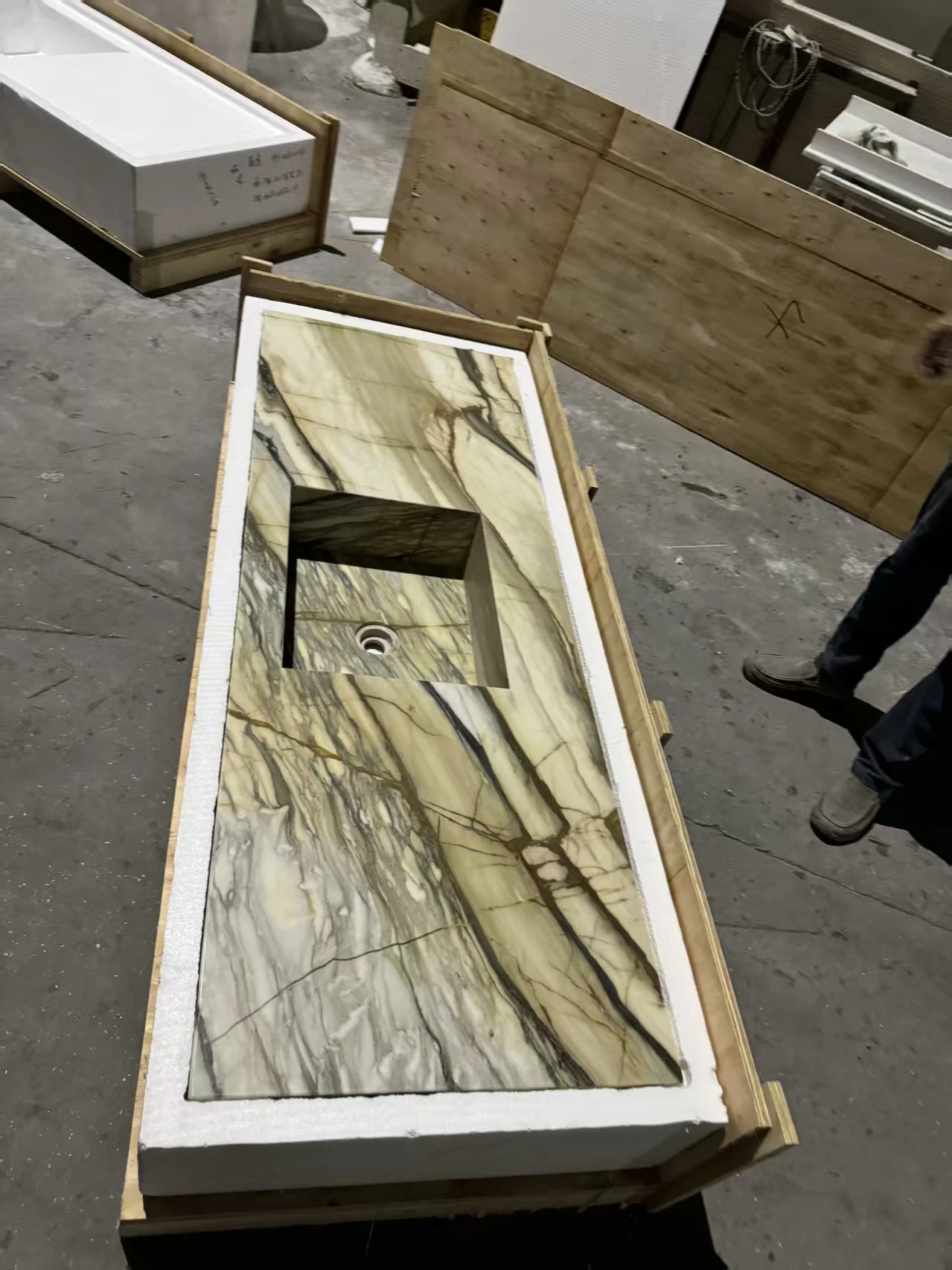
Export packing is part of product quality for cut-to-size stone. Finished pieces may pass through forklifts, container loading, sea freight, ports, trucks and jobsite storage. Weak packing can damage otherwise well-made stone.
Buyers should discuss reinforced wooden crates, bracing, foam or rubber separation, waterproof protection, edge protection, crate weight, lifting points and loading sequence. Thin panels, long strips, mitered edges, stone furniture parts and cutouts near corners may need extra support.
Labels should connect the crate to the shop drawings. A practical crate label may show project name, crate number, piece range, area, gross weight and handling direction. Installation teams benefit when packing follows the construction sequence.
Standards and References Buyers May Consider
Standards do not replace project judgment, but they help buyers and suppliers use a shared technical language. Depending on the material and application, buyers may refer to industry manuals, sustainability standards, ISO management systems and ASTM dimension stone specifications.
The Natural Stone Institute Dimension Stone Design Manual is relevant for design, installation details, terminology, countertops, wet areas, furniture, stairs and cladding. ANSI/NSI 373 may be relevant when a project includes sustainability expectations for natural dimension stone production.
ISO/TC 327 focuses on definitions, requirements and test methods for natural stones. ISO 9001 may help buyers evaluate quality management processes, while ISO 14001 may support environmental management discussions. ASTM C503/C503M and ASTM C615/C615M are useful references for marble and granite dimension stone respectively.
How to Reduce Risk When Ordering Cut-to-Size Stone from China
China can be suitable for cut-to-size stone fabrication when buyers manage drawings, material selection, inspection and packing communication carefully. The purchase should be handled as a technical project, not as a simple commodity order.
Common risks include wrong dimensions, inconsistent color, vein mismatch, hidden cracks, poor edge quality, inaccurate holes, unclear drawings, late changes, weak packing and insufficient inspection before shipment.
1. Confirm the application and material suitability before focusing only on price.
2. Provide architectural drawings, schedules and templates in clear formats.
3. Request current slab photos, videos and measurements before order confirmation.
4. Clarify thickness, finish, edge profile, holes, cutouts, tolerance and packing method.
5. Approve slab layout or vein matching for visually sensitive areas.
6. Request dry layout photos or videos for wall panels, stairs, furniture or book-matched work.
7. Review inspection photos before final packing and shipment.
8. Use clear crate labels linked to shop drawing numbers.
9. For a related procurement workflow, see How to Order Cut-to-Size Stone from China: A Practical Buyer Guide.
Frequently Asked Questions
Q: What is cut-to-size stone?
A: Cut-to-size stone is natural stone fabricated to agreed dimensions, thickness, finish, edge detail, holes, cutouts and piece numbering for a specific project.
Q: Is cut-to-size stone the same as tile?
A: No. Tile is usually modular and repetitive. Cut-to-size stone is produced according to project drawings and may include different sizes, special edges, holes, vein matching, slab layout control and export packing by area.
Q: What drawings are needed for a cut-to-size stone order?
A: In most projects, buyers do not already have dedicated stone shop drawings at the beginning. Buyers usually provide architectural drawings, design drawings, tender drawings, site dimensions, elevations, sections and CAD files where available. The stone supplier then develops project-specific stone shop drawings based on these documents for client review and approval before fabrication. Hardware templates may also be required for sinks, faucets, appliances and special cutouts.
Q: Can natural stone be vein matched before production?
A: Yes, in many cases. The supplier can prepare slab layout plans or dry layout proposals before cutting, but buyers should review current slabs and maintain realistic expectations about natural variation.
Q: Why is dry layout important?
A: Dry layout helps verify sequence, vein continuity, color balance, joint alignment, piece numbering and visible issues before packing and shipment.
Q: What tolerances should buyers discuss with suppliers?
A: Buyers should discuss length, width, thickness, squareness, flatness, edge profile, hole position, cutout size and joint requirements. Suitable tolerance depends on the material, application and installation method.
Q: How is cut-to-size stone packed for export?
A: It is typically packed in reinforced wooden crates with separation materials, edge protection, internal bracing, clear labels and container loading plans.
Q: Is China suitable for cut-to-size stone fabrication?
A: China can be suitable when buyers and suppliers manage shop drawings, slab confirmation, layout approval, inspection, dry layout, export packing and shipping documents professionally. For a related procurement workflow, see How to Order Cut-to-Size Stone from China: A Practical Buyer Guide.