


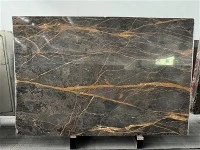
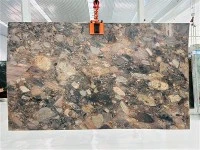
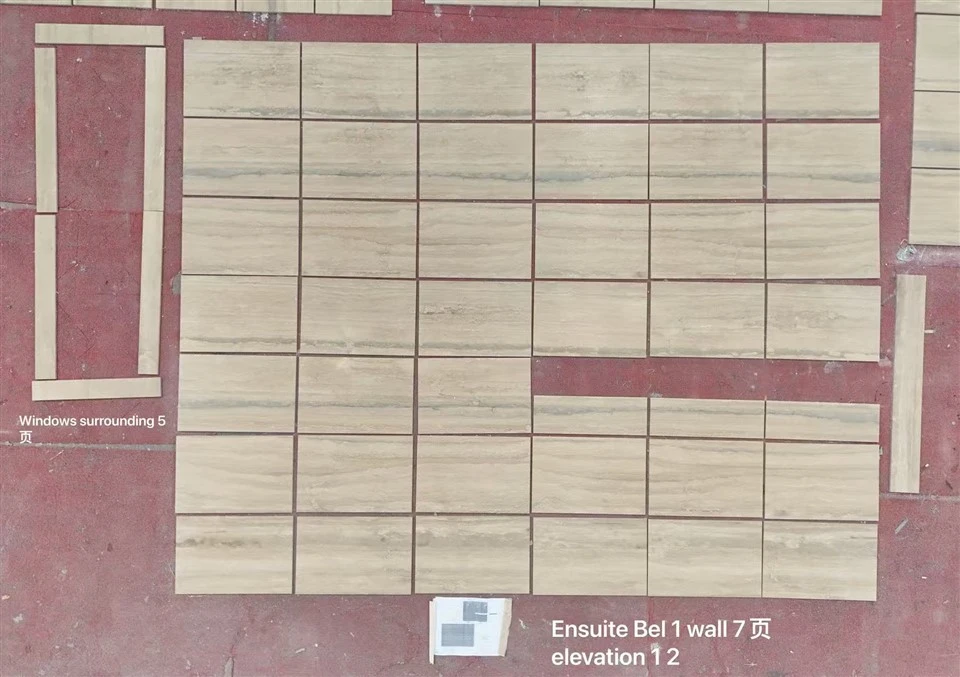

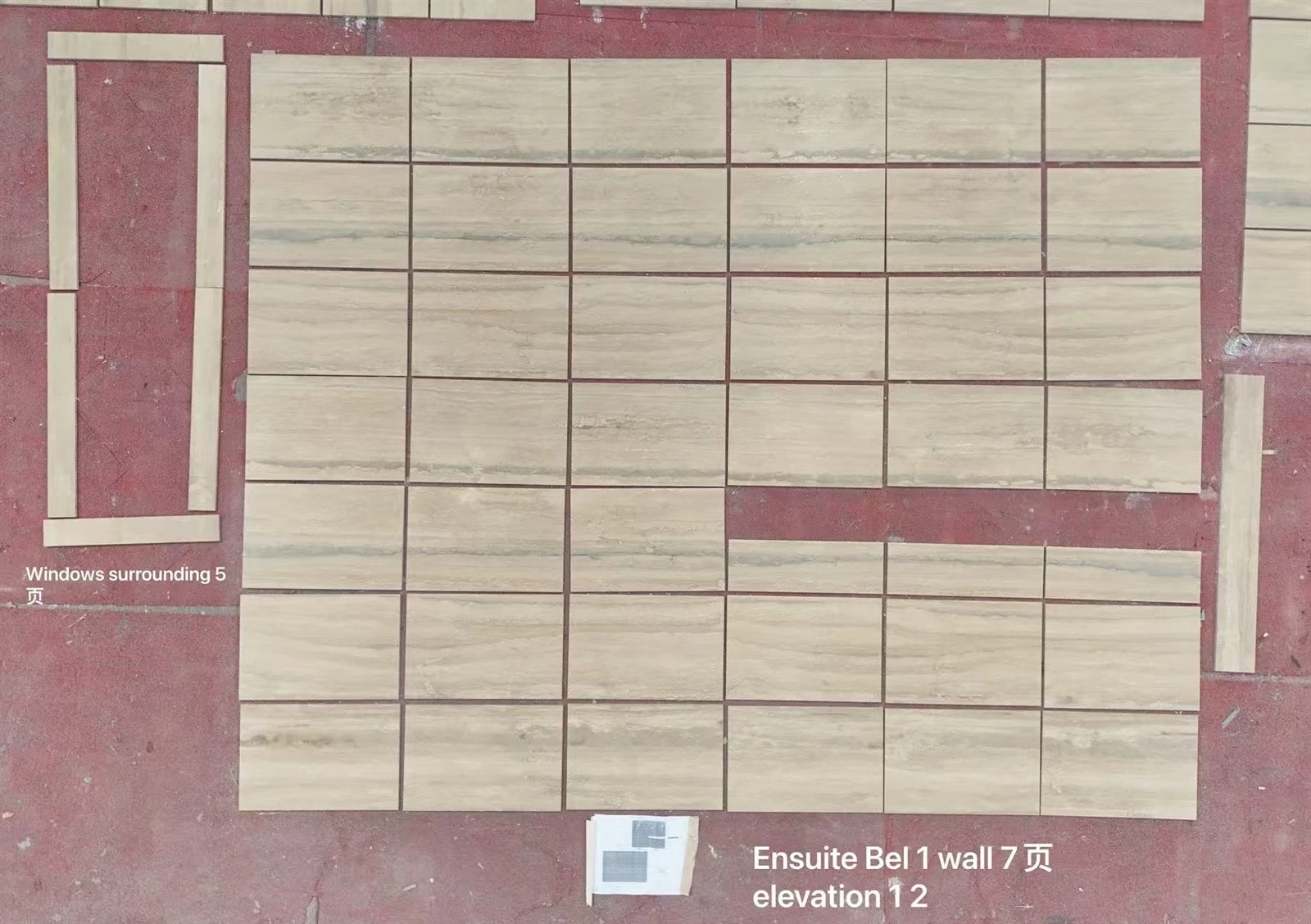
Factory dry layout of cut silver travertine wall tiles and window surrounds for pattern, quality and installation-sequence review.
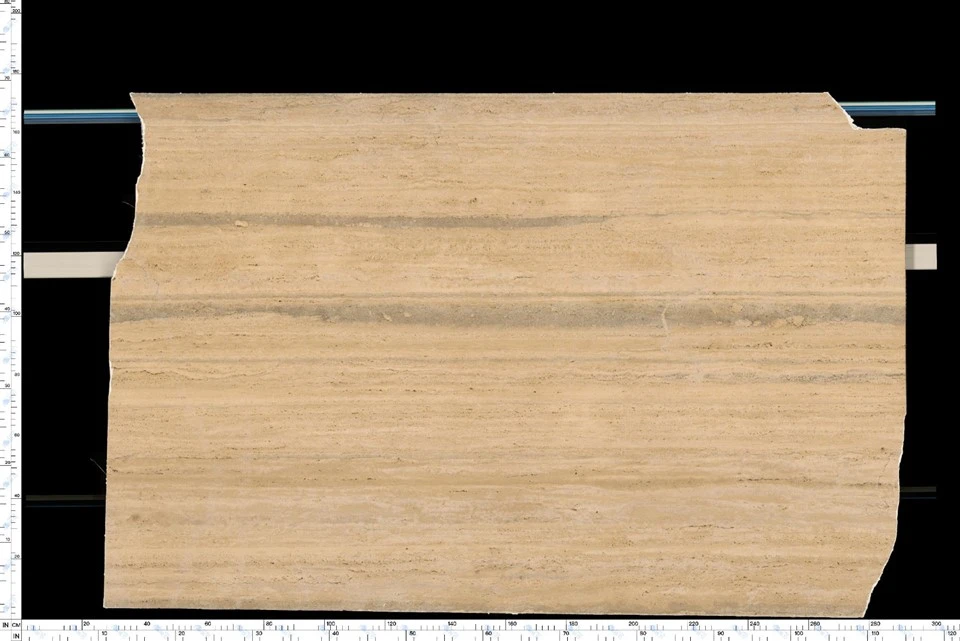
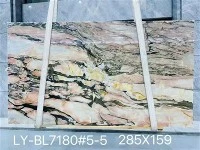
Full-size scan of an Italian silver travertine slab submitted for color, movement and natural-character approval.
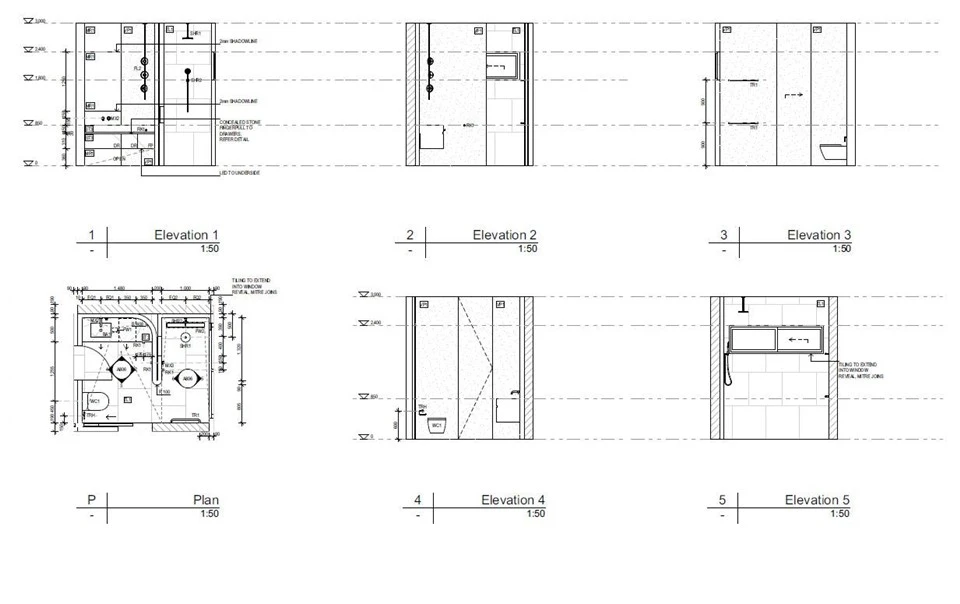
Bathroom architectural plan and wall elevations supplied for custom silver travertine wall tile shop drawings.
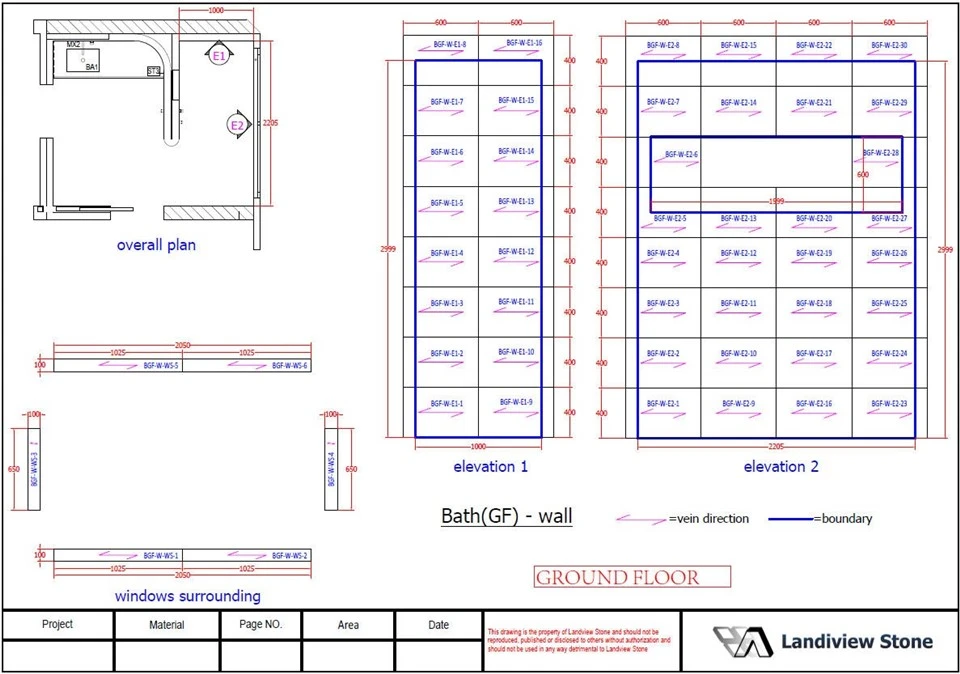
Landiview Stone shop drawings showing custom silver travertine wall tile sizes, vein directions, boundaries and unique piece numbers.
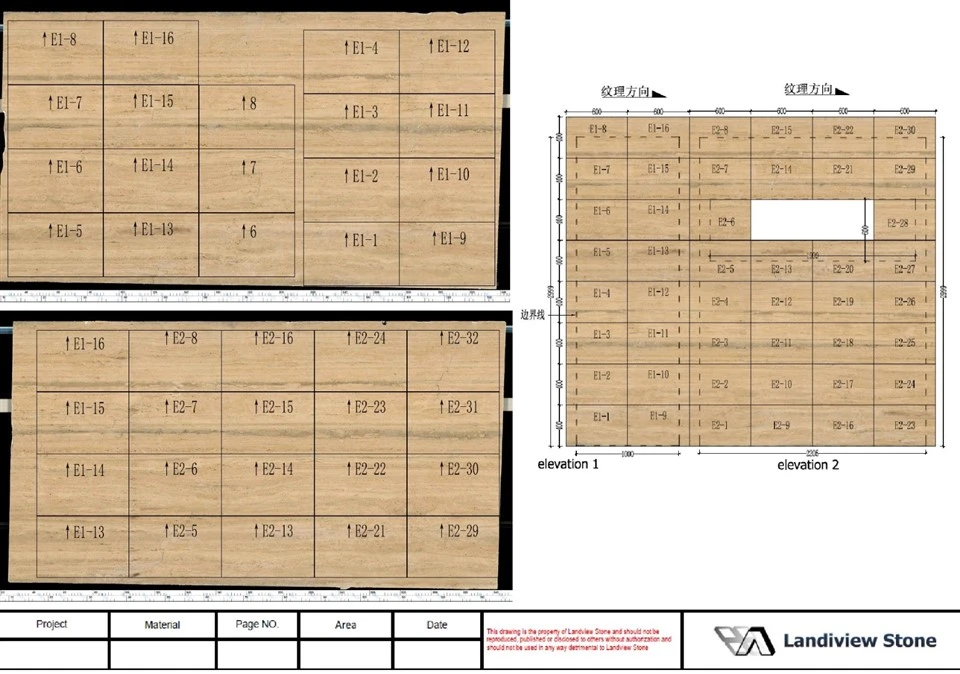
AutoCAD cutting and vein-layout simulation mapping numbered wall tiles onto approved silver travertine slab scans.
Italian Silver Travertine Wall Tiles
- Fast Delievery
- Quality Assurance
- 24/7 Customer Service
Executive Summary
These silver travertine wall tiles are a project-specific, cut-to-size package rather than anonymous loose tiles. The 18 mm Italian travertine is filled and honed, digitally planned from approved slab scans, inspected in a full factory dry layout, and individually numbered to help the site team reproduce the approved location and orientation.
Silver travertine has linear bands, tonal transitions, pores and other geological features that make slab approval and layout planning important. Filling closes the intended surface voids, while honing provides a low-sheen visible face. Natural variation remains part of the material and should be assessed across current slabs rather than inferred from one small sample.
Key Facts
| Specification Item | Project Information |
| Product | Custom silver travertine wall tiles |
| Material origin | Italy |
| Nominal tile thickness | 18 mm |
| Surface processing | Natural voids filled; visible face honed |
| Design input | Client architectural plans and wall elevations |
| Approval documents | Stone-specific shop drawings and current slab scans |
| Visual planning | AutoCAD cutting and vein-layout simulation based on approved slab scans |
| Installation control | Each finished tile receives a unique piece number coordinated with the approved layout |
| Factory quality control | Dry layout review for dimensions, finish, damage, orientation, color relationships and vein continuity |
| Availability | Current slabs, samples and matching range are subject to material availability |
How the Project Workflow Controls the Result
The workflow links design intent, actual slab appearance, fabrication and site installation through approved drawings, scan-based layout, unique piece numbers and factory dry layout. It reduces avoidable information gaps without treating natural stone or site installation as completely predictable.
- 1. Review the client's architectural plan and wall elevations to identify the stone scope, openings, returns, joints and dimensions.
- 2. Prepare stone-specific shop drawings that define tile sizes, boundaries, vein direction and unique piece references for client or design-team review.
- 3. Submit scans, images or videos of currently available Italian silver travertine slabs for approval of the color range, bands, pores, fissures and overall movement.
- 4. Import approved slab scans into AutoCAD and simulate cutting positions and the visual relationships between adjacent tiles. AutoCAD supports attaching raster-image references to drawings [3].
- 5. Issue the simulated cutting and vein layout for approval before physical cutting.
- 6. Fabricate the 18 mm tiles, fill the intended voids, hone the visible surfaces and retain the approved numbering logic.
- 7. Dry lay the finished pieces in their designed relationships; identify chipped edges, processing damage, unstable open fissures, unacceptable surface areas or visual mismatches.
- 8. Where replacement is needed, select a new cutting area with regard to adjacent color, band direction and composition rather than dimensions alone.
- 9. Mark every accepted tile with its unique reference and coordinate the same references with the installation information.
- 10. Apply project-specific protection and export packing appropriate to tile dimensions, geometry, destination and handling method.
Material, Finish and Natural Variation

Travertine is a natural dimension stone with characteristic voids and layered movement. ASTM C1527/C1527M-23 covers material characteristics, physical requirements and sampling for travertine selected for general building and structural purposes, while directing users to project-appropriate selection and use guidance [4]. A stone name alone does not establish suitability for every wall system or environment.
- • Filled: intended surface voids are filled during processing; the filling material and visual acceptance criteria should be agreed for the project.
- • Honed: the visible face receives a smooth, low-sheen finish rather than a high polish.
- • Natural pores and tonal bands: geological characteristics that can remain visually evident even after filling.
- • Natural fissure: a geological separation or mineralized feature that must be assessed for openness, stability, location and intended use.
- • Structural crack: a break that can affect integrity and requires technical evaluation; it should not be casually grouped with benign natural movement.
- • Fabrication defect: damage such as an unintended chip, break, scratch or processing mark introduced during manufacture or handling.
Mockups, current-lot samples, slab scans and defined acceptance criteria help teams discuss these distinctions. Final installation design must follow the project specification, applicable codes, substrate and setting-system requirements, and the recommendations of qualified installers and product manufacturers.

Where Silver Travertine Wall Tiles Are Used

Custom silver travertine wall tiles can be considered for bathroom walls, shower surroundings, vanity backsplashes, hotel and residential feature walls, lift lobbies, fireplace surrounds and coordinated window or door surrounds. Suitability depends on exposure, substrate, fixing method, joint design, cleaning regime and the selected stone lot.
For wet areas, the stone is only one part of the assembly. Waterproofing, drainage, movement accommodation, adhesives, sealants and attachment details must be specified and installed by responsible professionals in accordance with the project documents, local rules and product-manufacturer instructions [2].
What Buyers Should Specify Before Ordering
A technically complete inquiry produces a more useful quotation and reduces late-stage assumptions. Buyers should provide:
- • Architectural drawings, wall elevations, schedules, field dimensions and installation locations;
- • required tile sizes, 18 mm thickness confirmation, finish, filled-void expectations, visible faces and edge details;
- • openings, returns, niches, window surrounds, corners, joints and tolerances;
- • desired vein direction, matching logic, appearance range and slab-approval method;
- • substrate, waterproofing and attachment concept as defined by the responsible project professionals;
- • required shop drawing, slab scan, AutoCAD layout, dry layout, sample and inspection deliverables;
- • destination, packing constraints, unloading method and site installation sequence.
Frequently Asked Questions
Q: Can you provide samples?
A: Yes. Normally one or two samples can be provided without a sample charge. Typical sizes range from 100 × 100 mm to 200 × 200 mm. Courier cost is paid by the customer. Availability depends on the current material. A small sample is useful for reviewing finish and general color, but it cannot represent the full movement of a slab or completed wall.
Q: Can I see current slab photos and videos before ordering?
A: Yes. Subject to actual stock, Landiview Stone can provide current-lot slab images, videos, slab numbers, surface-review records and information about the available color and vein range. Buyers should approve the identified slabs and record the approval scope before layout work begins.
Q: Can Landiview Stone prepare stone shop drawings from architectural drawings?
A: Yes. Landiview Stone can extract the relevant stone scope and prepare stone-specific shop drawings for client and design-team review. Approved shop drawings coordinate fabrication information but do not replace the structural, waterproofing, code-compliance or installation responsibilities of locally licensed professionals. See What is cut-to-size stone?
Q: How do you help control the final vein layout and installed appearance?
A: Approved slab scans are used for AutoCAD cutting and vein-layout simulation. After approval, fabrication follows the mapped locations, and the finished tiles are dry laid and uniquely numbered. This reduces information mismatch between design, production and installation, but natural variation, image reproduction, replacement pieces, lighting, joints and site workmanship can affect the final appearance. See Natural stone slab layout in AutoCAD.
Q: How are the tiles protected during international transportation?
A: Packing is designed around tile geometry and the handling route. Protection may include internal lining, impact cushioning, custom foam, dividers, edge restraint and positioning supports. Narrow or elongated pieces may receive removable temporary support strips; these are transport protection and should be removed before installation according to the supplied instructions. Raw-wood packaging must use ISPM 15-compliant material where required by the destination country; ISPM 15 addresses phytosanitary measures for raw-wood packaging used in international trade [5]. See How to protect natural stone during shipping.
Q: How should installed silver travertine wall tiles be maintained?
A: Use a pH-neutral cleaner intended for natural stone, address spills promptly, rinse as appropriate and avoid unidentified acidic or alkaline cleaners and abrasive tools. The Natural Stone Institute notes that calcareous stone is sensitive to acidic solutions and recommends mild, non-acidic or neutral cleaning products [6]. Sealer selection and reapplication intervals depend on the stone, finish, exposure and sealer manufacturer's instructions; follow project specifications and qualified maintenance advice.
Q: Are these silver travertine tiles filled and honed?
A: Yes. The project shown uses 18 mm Italian silver travertine with the intended voids filled and the visible faces honed. Buyers should still define acceptable filling, pinholes, tonal range, edge treatment and visible-face criteria in approved documents.
Q: Why does every tile have a unique number?
A: The unique number connects each physical tile to a defined wall location and orientation. Coordinating those numbers with the layout or installation drawing helps reduce wrong-position, wrong-direction and wrong-adjacency errors on site.
Q: Why is factory dry layout necessary after AutoCAD layout approval?
A: The AutoCAD layout previews the planned result from slab scans; the dry layout shows the finished physical pieces. It allows inspection for chips, processing damage, unstable open fissures, finish issues, orientation, color relationships and vein continuity. It also provides context for selecting a visually compatible replacement when required.
Q: What information is needed for a quotation?
A: Provide architectural drawings, measured dimensions where available, tile schedule, required quantity, thickness, finish, edge details, openings, joint concept, vein-direction preference, approval deliverables, destination and packing requirements. Pricing, lead time and material matching are project-specific and subject to current slab availability.
About Landiview Stone
Landiview Stone supplies natural stone in two principal forms: slabs for importers, distributors and fabricators, and project-specific cut-to-size or finished products for contractors, developers, designers, builders and other project buyers.
For slab buyers, support can include current slab selection, slab-image review, color and vein-range confirmation, surface inspection, slab identification and export packing. For custom projects, the team can coordinate shop drawing review, slab scanning, AutoCAD cutting and vein-layout simulation, fabrication, dry layout, piece numbering, finished-product inspection, temporary reinforcement for vulnerable components and project-specific export protection.
For geometrically complex stone assemblies, three-dimensional modeling and virtual assembly review may be used to examine component relationships, material thicknesses, surface treatments, concealed reinforcement and possible interference before fabrication details are finalized.
Landiview Stone's stated international project experience includes:
- • Marble furniture, bathroom vanity tops and shower wall panels for the Grand Hyatt Singapore renovation project
- • Stone supply for stations on Singapore's Thomson-East Coast Line
- • Interior stone products for the Wynn project in the United Arab Emirates
- • Marble products for public areas of the 255 East 77th Street luxury residential project in New York
- • Interior and exterior marble and granite products for three high-end custom homes on Tuckahoe, a private resort island in Massachusetts, USA
Request A Quote
Send Landiview Stone your architectural drawings, tile schedule, approximate quantity, finish requirements, destination and approval expectations. The project team can review current Italian silver travertine availability and propose the appropriate shop drawing, slab-selection, vein-layout, dry-layout and packing scope.
Silver Travertine Tiles Project Inquiry
Hot Tags: silver travertine wall tiles, Italian silver travertine, filled honed travertine tiles, custom stone wall tiles, numbered stone tiles, Landiview Stone
You Might Also Like

Send Inquiry