

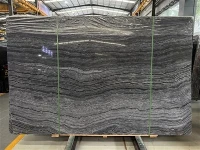
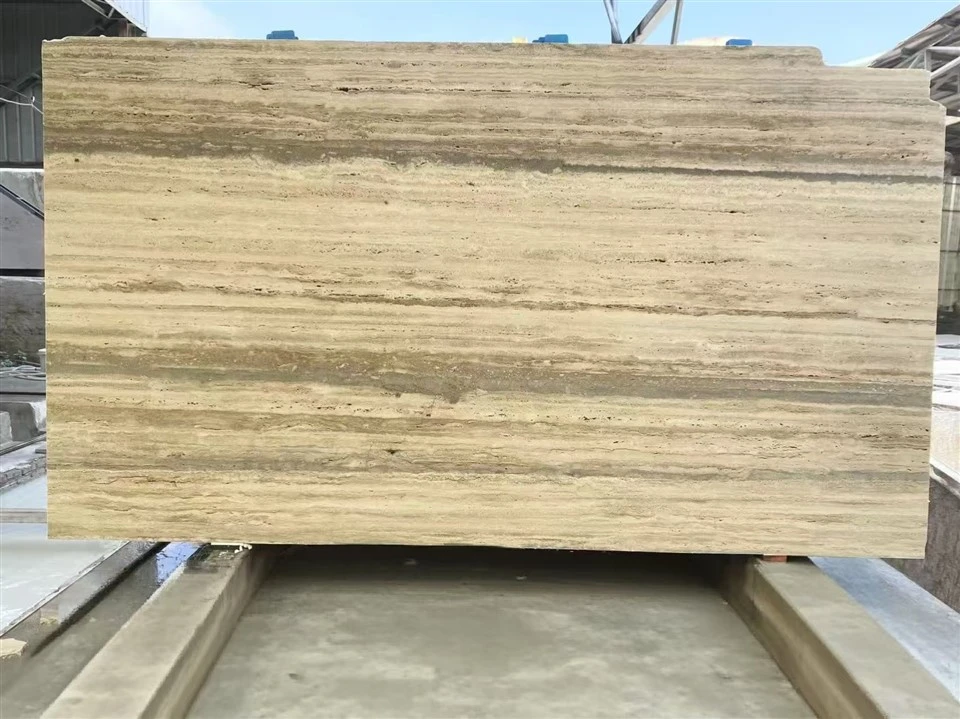

Silver Grey Travertine slab featuring natural horizontal linear veining in layered grey, beige and warm taupe tones.

Custom Silver Grey Travertine kitchen island with waterfall ends and matching stone drawer fronts in a contemporary kitchen.

Custom Silver Grey Travertine bathroom vanity with two integrated stone sinks, matching backsplash and filled honed finish.

Large-format Silver Grey Travertine wall tiles with visible joints installed behind the reception desk in a luxury hotel lobby.

Large-format Silver Grey Travertine floor tiles with visible grout joints installed in a contemporary custom home living room.

Custom interior staircase clad in Silver Grey Travertine with matching treads, risers, landing and glass balustrades.

Custom Silver Grey Travertine bathtub deck and surrounds with matching wall cladding in a contemporary luxury bathroom.
Italian Silver Travertine Slab
- Fast Delievery
- Quality Assurance
- 24/7 Customer Service
Executive Summary
Choose Silver Travertine when a project needs warm beige stone with directional silver-grey movement and the natural open-pore character of travertine. The principal purchasing decisions are the actual slab range, vein cut or cross cut, finish, hole-filling level, thickness and intended application.
Silver Travertine slab is a natural travertine supplied as Italian-origin material, with a beige field crossed by silver-grey veins. It is intended for slab importers, distributors and fabricators, as well as stone contractors, interior designers, developers and builders purchasing custom-fabricated work. Recommended uses include kitchen islands and countertops, bathroom vanity tops, floor and wall tiles, interior staircases, and bathtub decks and surrounds. Landiview Stone can quote current slabs or project-specific cut-to-size and finished products. Buyers should approve identified current slabs, the chosen filling level and all fabrication requirements before production because natural color, pores, veins and fissures vary from piece to piece.

Key Facts
The standard offering is 18 mm Italian Silver Travertine slab. Polished and honed surfaces, vein-cut and cross-cut presentations, and three hole-filling levels allow the material to be matched to different design, fabrication and budget priorities. All order-specific details remain subject to current slab or block availability and written approval.
| Specification | Confirmed Product Information |
| Product name | Silver Travertine slab, also described commercially as Silver Grey Travertine |
| Material | Natural travertine, a calcium-carbonate-based stone in the limestone family [1] |
| Origin | Italy. |
| Color and visual character | Beige color with silver-grey veins; actual shade, pore distribution and movement vary by slab. |
| Standard slab thickness | 18 mm |
| Optional thickness | 20 mm or 30 mm slabs may be specially cut from selected blocks according to customer requirements, subject to suitable block availability, quantity and production review. |
| Thickness tolerance | Stated standard: ±1 mm. Measurement method and project acceptance criteria must be confirmed in the contract, drawings or inspection standard before ordering. |
| Recommended finishes | Polished or honed |
| Cut orientation | Vein cut or cross cut |
| Hole-filling options | Large holes only; large holes plus approximately 80% of small holes; or nearly all visible holes filled. |
| Recommended applications | Kitchen islands and countertops, bathroom vanity tops, floor tiles, wall tiles, interior staircases, and bathtub decks and surrounds. |
| Supply forms | Slabs for importers, distributors and fabricators; cut-to-size or finished products for project buyers. |
| Testing and suitability | No lot-specific physical test values are claimed on this page. Request available reports and assess the selected material against the project specification, intended use and local requirements. ASTM lists C1527/C1527M as the material specification for travertine dimension stone [2]. |
Available Finishes and Processing Options
Specify finish, cut orientation and filling level together. A polished or honed surface changes reflectivity and color perception; vein cut or cross cut changes the pattern direction; and the filling specification changes pore visibility, cleaning behavior, appearance and processing cost.
▌ Polished Finish
A polished finish increases reflection and usually gives the beige and silver-grey contrast a deeper, more formal appearance. It can suit vertical features, vanity tops and decorative furniture where a reflective finish supports the design. Buyers should approve the actual polish level and filler appearance on representative material. Because travertine is calcium-carbonate based, acidic spills and cleaners can alter the surface, and a polished finish does not remove that sensitivity [1][3]. Slip resistance and local requirements must be reviewed before polished stone is specified for floors, steps or wet areas.
▌ Honed Finish
A honed finish has a lower-sheen, softer visual character that can make Silver Travertine easier to coordinate with timber, metal and restrained interior palettes. It is commonly considered for floors, wall panels, stairs, bath surrounds and contemporary countertops. Honing does not make the stone stain-proof, acid-proof or maintenance-free. Confirm the target sheen, tactile expectation, sealer compatibility and cleaning regime with the project team and product manufacturers.
▌ Vein Cut or Cross Cut
Vein cutting follows the sedimentary bedding to reveal long, directional bands like the horizontal movement seen in typical Silver Travertine slabs. Cross cutting intersects the bedding and produces a more clouded or mottled presentation. The two orientations are not merely stylistic labels; they affect how adjoining pieces read across islands, walls, stair flights and tile fields. State the required orientation on approved samples, slab images and shop drawings, and do not assume every slab can provide both effects.
▌ Three Filling Levels
- • Large holes only: the lowest-cost option. More small pores remain visible, giving a more open natural surface. The buyer should confirm whether the remaining pores are compatible with cleaning, hygiene, edge fabrication and the intended installation.
- • Large holes plus approximately 80% of small holes: the medium-cost option and the most frequently selected level for Landiview Stone orders. It balances recognizable travertine character with a more closed working surface. "Approximately 80%" must be interpreted against approved samples and inspection criteria rather than as a pore-by-pore guarantee.
- • Nearly all visible holes filled: the highest-cost option. It is selected when a more continuous surface is preferred, especially for tops or wet-use components. Natural micro-voids, filler boundaries or later maintenance needs may still remain, so "nearly all" does not mean permanently pore-free.
Filler type, color, finish response and acceptance range should be documented before production. Filled areas may differ subtly in gloss, tone and aging from the surrounding stone. The final specification must reflect exposure, hygiene expectations, fabrication geometry, installer recommendations and any applicable project rules.
Recommended Applications
Silver Travertine can create coordinated horizontal and vertical surfaces across residential, hospitality and commercial interiors. Application approval should consider the current slab range, filling level, finish, support, edge and cutout geometry, exposure to acids or water, slip resistance, installation system and local requirements.
▌ Kitchen Islands and Countertops

Directional silver-grey veins can turn a kitchen island into a strong linear feature, especially when the top, waterfall ends and visible drawer or cabinet-facing pieces are planned from identified slabs. For countertops, select a filling level compatible with food-area cleaning and approve seams, edges, backsplash relationships and surface finish. Travertine is acid-sensitive, so citrus, vinegar, wine and acidic cleaners can etch or alter the surface [1][3]. It should be chosen with realistic care expectations rather than treated as a chemically resistant engineered surface.
Large sink and cooktop openings create vulnerable bridges. Depending on the material, geometry and site plan, Landiview Stone may propose a semi-cutout in which selected connections remain for transport and are completed on site. Retained locations, tools, site responsibility, edge support and final cutting method must be shown in approved documents. Sink templates, faucet specifications, spout reach, backsplash thickness and cabinet clearances must be checked before release.
▌ Bathroom Vanity Tops
Silver Travertine works well for a vanity composition when the top, integrated sink, backsplash and visible apron are coordinated as one assembly. A honed, substantially filled surface can support a quieter contemporary appearance, while polished material gives stronger contrast. Integrated sinks require coordinated slopes, outlet geometry, joints, wall interfaces and access for installation. Water testing may be agreed for fabricated sink products, but it does not replace correct site plumbing, support, sealing and installation.
Toiletries and cleaners may contain acids or colorants. Prompt spill response, a pH-neutral stone cleaner and manufacturer-compatible sealing decisions are appropriate starting points [3]. Final maintenance and waterproofing arrangements must follow the project specification and qualified installer recommendations.

▌ Floor Tiles

Vein-cut tiles create directional bands; cross-cut tiles create a more dispersed field. Buyers should identify tile module, thickness, finish, filling range, joint width, layout direction and acceptable variation before cutting. A dry review of representative groups can help distribute strong dark bands and lighter areas deliberately rather than randomly. Floors also require substrate, movement-joint, adhesive, grout, lippage, slip resistance and load assessments by the responsible project professionals. The Natural Stone Institute design manual covers broader guidance for horizontal installations, wet areas, testing and tolerances [4].
▌ Wall Tiles
Large-format Silver Travertine wall tiles can form a continuous layered backdrop in hotel lobbies, lift areas, bathrooms and residential feature walls. The design value comes from controlling band direction, panel sequence and joint alignment. Select slabs with sufficient usable area and agree how pores, fillers, fissures and tonal changes are distributed. Panel size, backing, anchor or adhesive system, substrate, joints and installation sequence must be engineered for the actual location by the responsible professionals; a visual slab layout is not an attachment design.

▌ Interior Staircases

Matching treads, risers and landings can carry the stone's bands through an entire stair flight. The shop drawings should coordinate finished levels, tread depth, riser height, nosing, joints, support, edge construction and any interfaces with balustrades. The finish must be evaluated for slip resistance, expected traffic and local code. Narrow nosings and long treads can be vulnerable during handling, so inspection, temporary protection and packing should be planned around the final geometry rather than treated as standard tile packing.
▌ Bathtub Decks and Surrounds
A bathtub deck and surrounding wall cladding can use the same slab family to create a coordinated enclosure. Review the relationship between deck pieces, upstands, access panels, wall panels and plumbing penetrations before cutting. A higher filling level may simplify routine cleaning, but filler and sealer choices still require compatibility checks. Waterproofing, movement accommodation, support, sealant joints and wet-area installation remain site-system responsibilities. Use non-acidic care products and follow the maintenance guidance for the selected stone and finish [3][4].

Why Choose This Stone
Silver Travertine offers a recognizable Italian travertine character without relying on a uniform manufactured print: warm beige layers, silver-grey movement and visible geological pores. It is a practical candidate when buyers want a classic natural-stone appearance, multiple cut and fill options, and a generally accessible price position relative to many rare decorative stones.
This Silver Travertine is presented as a classic Italian natural stone with substantial historical and contemporary design use. Its neutral beige base coordinates readily with warm metals, timber, glass and grey architectural finishes, while the silver-grey veins add direction and depth. The material is widely recognized by designers and end users under Silver Travertine or Silver Grey Travertine naming, but commercial names can vary across suppliers; purchase decisions should therefore be made from the current slabs and written specification, not the name alone.
- • Distinctive but adaptable appearance: the color family is restrained, while vein-cut slabs can make islands, walls and stairs visually directional.
- • Flexible specification: polished or honed surfaces, vein-cut or cross-cut presentation, and three filling levels give buyers meaningful control over appearance and processing cost.
- • Broad interior use: one material family can coordinate countertops, vanities, floors, walls, stairs and bathing areas when the relevant technical requirements are satisfied.
- • Commercial positioning: the product is not presented as a rare or prohibitively priced stone. It is generally positioned as a cost-conscious natural-stone option, but actual pricing depends on slab grade, dimensions, yield, filling, thickness, fabrication, packing and logistics.
Travertine's pores and calcium-carbonate composition are part of its identity and must be specified honestly. Natural voids, veins and fissures are not automatically defects, while open or unstable features that affect handling, fabrication or service must be evaluated separately. Current slab photographs, videos, sample review and a project-specific inspection agreement help distinguish acceptable natural character from nonconforming workmanship.
Comparison with Similar Stones
Compare materials by geology, actual slab appearance, porosity, acid sensitivity, finish, application and maintenance, not by color alone. Silver Travertine is a calcium-carbonate-based natural stone with characteristic pores; it should not be assumed to perform like quartzite, granite or engineered quartz.
| Stone | Typical Visual Direction | Material Category | Typical Uses | Buyer Considerations |
| Italian Silver Travertine | Beige field with silver-grey linear bands when vein cut; more clouded movement when cross cut | Natural travertine; calcium-carbonate-based limestone family [1] | Countertops, vanities, floors, walls, stairs, bathtub decks and surrounds | Approve current slabs, cut direction, filling coverage, finish and expected acid sensitivity. Do not assume every lot has the same grey-to-beige balance. |
| Classic beige travertine | Warm cream to beige bands or mottled cross-cut pattern, usually with less grey emphasis | Natural travertine | Floors, walls, stairs, bathrooms and architectural details | Similar pore and acid-sensitivity considerations; evaluate whether a warmer, less silver-grey palette better suits the project. |
| Grey limestone | More uniform grey, fossil movement or fine clouds rather than elongated travertine voids | Natural limestone; exact composition and properties vary | Flooring, wall panels, vanities and architectural work | May provide a calmer grey field, but it is not a visual or technical substitute by default. Confirm tests, finish, absorption and use limitations for the selected variety. |
| Grey marble | Crystalline or cloudy grey field with white, dark or branching veins | Natural marble; calcium-carbonate based | Vanities, walls, floors, stairs and decorative surfaces | Different crystalline texture and usually fewer travertine-like pores. Acid sensitivity remains relevant; test and approve the actual lot and finish. |
| Grey natural quartzite | Layered, crystalline or sweeping movement; generally no travertine-style open pore structure | Natural quartzite, subject to geological verification | Countertops, islands, vanities and feature surfaces | Typically selected where a siliceous composition is desired, but cost, fabrication behavior, fissures and lot variation differ. Do not rely on a commercial name alone. |
| Grey engineered quartz | Controlled repeatable background or printed vein design | Manufactured composite surface | Interior countertops and vanities, within manufacturer limitations | More pattern consistency, but it does not reproduce natural travertine pores and bedding. Follow the manufacturer's heat, UV, fabrication, installation and warranty requirements. |
Frequently Asked Questions
Most Silver Travertine purchasing risk can be reduced by defining the actual slabs, thickness and tolerance, cut orientation, filling level, finish, fabrication drawings, inspection scope and packing method before production. The answers below describe Landiview Stone's normal process; each order remains subject to current material and written agreement.
Q: Can you provide Silver Travertine samples?
A: Yes. Normally one or two samples can be provided without a sample charge, with typical sizes from 100 × 100 mm to 200 × 200 mm. Courier cost is paid by the customer, and sample availability depends on the current material. A small sample is useful for reviewing finish, filler color, basic tone and surface character, but it cannot represent the full banding, pore distribution or tonal range of a slab. For order approval, combine sample review with identified current slab photos, videos or scans.
Q: What is your Silver Travertine slab thickness tolerance?
A: The stated standard thickness tolerance is ±1 mm. Before ordering, the buyer and supplier should confirm the nominal thickness, measurement equipment, measurement points, surface condition, sampling plan and acceptance criteria in the contract, drawings or inspection standard. Do not assume that a general tolerance automatically resolves installation build-up, adjoining-material levels, edge lamination or calibrated-tile requirements. Project-specific requirements should be agreed in writing before production and checked against the selected product form.
Q: How do you inspect Silver Travertine slab surface quality?
A: Inspection focuses on cracks or unstable features that may affect handling or fabrication, overall visual coordination, abnormal large black areas that conflict with the approved range, and color and vein variation against the buyer's approval. Inspectors must distinguish inherent pores, veins, filled areas and natural fissures from structural cracks, unstable conditions or processing defects. The agreed filling level, finish, slab IDs, usable dimensions and any marked exclusions should form part of the acceptance record. Natural variation is expected, but that does not remove the need to identify features that could affect use or yield.
Q: Can I see current slab photos and videos before ordering?
A: Yes, subject to actual stock availability. Landiview Stone can provide images or videos of identified current slabs, slab numbers, surface-review information and confirmation of the available color and vein range. Buyers should state whether the priority is warmer beige, stronger silver-grey bands, more uniform movement, a specific cut direction or usable yield. Images are decision aids, not exact color guarantees, because lighting, reflections, camera settings, screen calibration and surface finish can change what is displayed. Final approval should reference the specific slabs and revision date.
Q: Can you supply cut-to-size and finished products, not only slabs?
A: Yes. The normal workflow is: the customer submits architectural drawings; Landiview Stone prepares stone shop drawings for review; current slab images are submitted, or block selection and special slab cutting may be investigated if existing slabs are unsuitable; approved slab scans are used for AutoCAD cutting and vein-layout simulation; fabrication proceeds after approval; and finished pieces are dry laid, inspected, replaced where nonconforming, numbered, protected and packed. Vulnerable areas may receive temporary reinforcement. See the detailed guide to ordering cut-to-size stone from China.
Q: Can Landiview Stone prepare stone shop drawings from architectural drawings?
A: Yes. The technical team can review architectural information, identify the stone scope and prepare stone shop drawings showing relevant dimensions, thicknesses, cutouts, edge details, visible faces, finishes, joints and other fabrication requirements. The customer and design team must review and approve the drawings before production. Supplier shop drawings coordinate stone fabrication; they do not replace the structural, waterproofing, attachment, code or installation responsibilities of locally licensed professionals. For additional context, read what cut-to-size stone means for project procurement.
Q: How do you help control the final vein layout and installed appearance?
A: After shop drawings and actual slabs are approved, calibrated slab scans can be used in AutoCAD to place cut-piece outlines and review vein direction, color distribution and adjoining relationships before cutting. The buyer approves the layout, fabrication follows the controlled documents, and physical dry layout checks the actual finished pieces. Piece numbering then links the approved arrangement to packing and installation drawings. This process reduces information gaps but cannot guarantee identical color on every screen or eliminate natural variation, fabrication tolerances and site adjustments. See natural stone slab layout in AutoCAD.
Q: How do you protect slabs and finished stone during shipping?
A: Slabs are packed in robust export-suitable wooden frames, crates or A-frame support arrangements designed for the actual container plan. Finished products may use liners, cushioning, custom foam, plywood separators, edge protection and positioning supports. Sink or cooktop cutouts, narrow backsplashes, thin strips, vanity tops, fireplace parts, narrow wall panels and vulnerable corners may receive temporary support strips over protective film; these are removed before installation according to instructions. Raw-wood packaging must meet applicable destination-country rules, including ISPM 15 where required [5]. Slab unloading and handling require trained controls [6]. Read Landiview Stone's shipping protection guide.
Q: How should Silver Travertine be maintained after installation?
A: Use a pH-neutral cleaner intended for natural stone, address spills promptly, and avoid unknown acidic or alkaline cleaners and abrasive tools. Travertine is calcium-carbonate based and is vulnerable to acids, so citrus, vinegar and acidic bathroom cleaners can alter the finish [1][3]. Blot rather than spread spills, rinse as appropriate and use soft cleaning materials. Sealer selection, suitability and reapplication interval depend on the stone, filling, finish, exposure, installation environment and sealer manufacturer's instructions. Test products in an inconspicuous area and follow the project specification and professional maintenance advice.
Q: Is Silver Travertine suitable for kitchen countertops?
A: It can be used for kitchen countertops when the buyer accepts travertine's pores, acid sensitivity and maintenance requirements and when the geometry, support and fabrication details are appropriate. A higher filling level may make routine cleaning more practical, while honed or polished appearance remains a design choice. Use boards, trivets and prompt spill response, and avoid acidic cleaners [1][3]. Large openings, narrow bridges and unsupported overhangs require project-specific review. Final suitability rests with the project specification, responsible design professionals, fabricator and installer.
Q: What is the difference between vein-cut and cross-cut Silver Travertine?
A: Vein cut follows the bedding and emphasizes long parallel bands, while cross cut intersects the bedding and shows a more clouded or mottled pattern. Vein cut is often selected for directional islands, wall panels and stairs; cross cut can create a more dispersed tile field. Availability and usable size depend on how the blocks were sawn and on the selected batch. Specify the cut orientation in the quotation, approved sample, slab images and shop drawings so that the design intent is not left to interpretation.
Q: How is Silver Travertine priced?
A: Pricing is project-specific. Silver Travertine is generally positioned as a comparatively accessible classic Italian natural stone rather than a rare decorative material, but a reliable quotation still depends on current slab or block availability, grade, dimensions, usable yield, thickness, cut direction, filling level, finish, quantity, fabrication complexity, dry layout, replacement allowance, packing and destination logistics. Compare supplier quotations against the same stone range, filling criteria and scope. A low square-metre figure may not include the same usable quality, processing or export protection.
Q: Can you specially cut 20 mm or 30 mm Silver Travertine slabs?
A: Landiview Stone can investigate selecting suitable rough blocks and specially cutting 20 mm or 30 mm slabs according to customer requirements. Feasibility depends on current block availability, required quantity, target slab dimensions, cut orientation, quality range, processing plan and commercial terms. Because special slab cutting is a production commitment rather than a simple stock substitution, buyers should define the expected finish, filling, tolerance, inspection method, usable-area criteria and approval process before the block is released for sawing.
Why Landiview Stone
Landiview Stone supports two different procurement paths: selected slabs for importers, distributors and fabricators, and drawing-controlled cut-to-size or finished stone for project buyers. The practical difference is the ability to connect stone selection with shop drawings, digital slab layout, fabrication inspection, piece identification and export protection.
▌ Supply Formats and Buyer Support
Landiview Stone supplies natural stone in two principal forms: slabs for importers, distributors and fabricators, and project-specific cut-to-size or finished stone products for contractors, developers, designers, builders and other project buyers. For slab buyers, support can include current-slab selection, slab-image review, color and vein-range confirmation, surface inspection, slab identification and export packing.
▌ Project Coordination Workflow
For cut-to-size and custom-fabrication work, the process is designed to connect the approved design information to identifiable finished pieces:
- 1. Review architectural drawings and identify the stone scope.
- 2. Prepare stone shop drawings for client and design-team approval.
- 3. Submit available slabs; if unsuitable, investigate block selection and special slab cutting when appropriate.
- 4. Use approved slab scans in AutoCAD to simulate cutting and vein layout before production.
- 5. Fabricate to approved documents, then dry lay, inspect and number finished pieces.
- 6. Replace nonconforming pieces when required while considering adjacent color and veining.
- 7. Apply project-specific protection, including temporary reinforcement for vulnerable geometry, before export packing.
AutoCAD layout predicts where pieces should be cut; physical dry layout checks what fabrication actually produced. At dry layout, the team can review edge or corner damage, processing damage, potentially unstable fissures, unexpected visual differences and agreed appearance criteria. Piece numbers may then be coordinated with installation drawings to communicate position, adjacency and orientation.
▌ Complex Stone Assemblies
For more complex fabricated and assembled stone products, individual components may be modeled and virtually assembled in Autodesk Inventor or SolidWorks. This review can examine component relationships, material thicknesses, surface treatments, internal clearances, concealed reinforcement, cutout positions and potential interference before fabrication details are finalized. It is a coordination method, not a substitute for licensed structural, attachment, plumbing, waterproofing or installation design.
Fragile finished components may receive protective film and temporary reinforcement strips over vulnerable openings, narrow edges, elongated parts or corners. Internal packing may include custom foam, plywood separation or support, edge protection and positioning elements. The external crate or frame is designed around product geometry, weight, handling and container conditions. OSHA's advisory confirms that slab loading, unloading, storage and movement require trained procedures and hazard controls [6].
▌ Selected International Project Experience
- • Marble furniture, bathroom vanity tops and shower wall panels for the Grand Hyatt Singapore renovation project
- • Stone supply for stations on Singapore's Thomson-East Coast Line
- • Interior stone products for the Wynn project in the United Arab Emirates
- • Marble products for public areas of the 255 East 77th Street luxury residential project in New York
- • Interior and exterior marble and granite products for three high-end custom homes on Tuckahoe, a private resort island in Massachusetts, USA
The technical content on this page draws on Landiview Stone's actual project coordination and factory practices. External standards and industry sources are used only to explain broader material, design, care, packing or handling principles. Every method should be evaluated against the selected stone, geometry, transport route, site conditions, destination rules and project specification.
Request a Quote
To receive a useful Silver Travertine proposal, send the required slab or finished-product dimensions, nominal thickness, quantity, finish, vein-cut or cross-cut preference, filling level, application and delivery destination. Include architectural drawings, stone schedules or fabrication details when available.
Check Current Silver Travertine Slabs or Request a Project Quote
Landiview Stone can review current slab availability, provide identified slab photos or videos, and prepare quotations for slabs, cut-to-size pieces or custom-fabricated products. For project orders, the technical team can also coordinate stone shop drawings, scanned-slab cutting and vein-layout simulation, dry-layout inspection, piece numbering and project-specific export packing.
Please identify any approval deadline, target delivery window or special inspection requirement in the inquiry. Availability, production planning and logistics will be assessed against the actual scope rather than assumed in advance.
Request A Project Quote Or Slab Availability
Hot Tags: Silver Travertine slab, Italian Silver Travertine, Silver Grey Travertine, vein cut travertine, cross cut travertine, filled travertine slab, travertine supplier, travertine fabrication, Landiview Stone, Tra onyx Jade Tavertine Slabs, Travertine
Previous
No InformationYou Might Also Like



Send Inquiry