

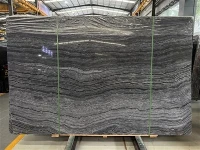
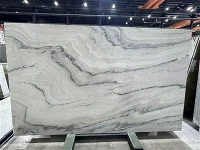
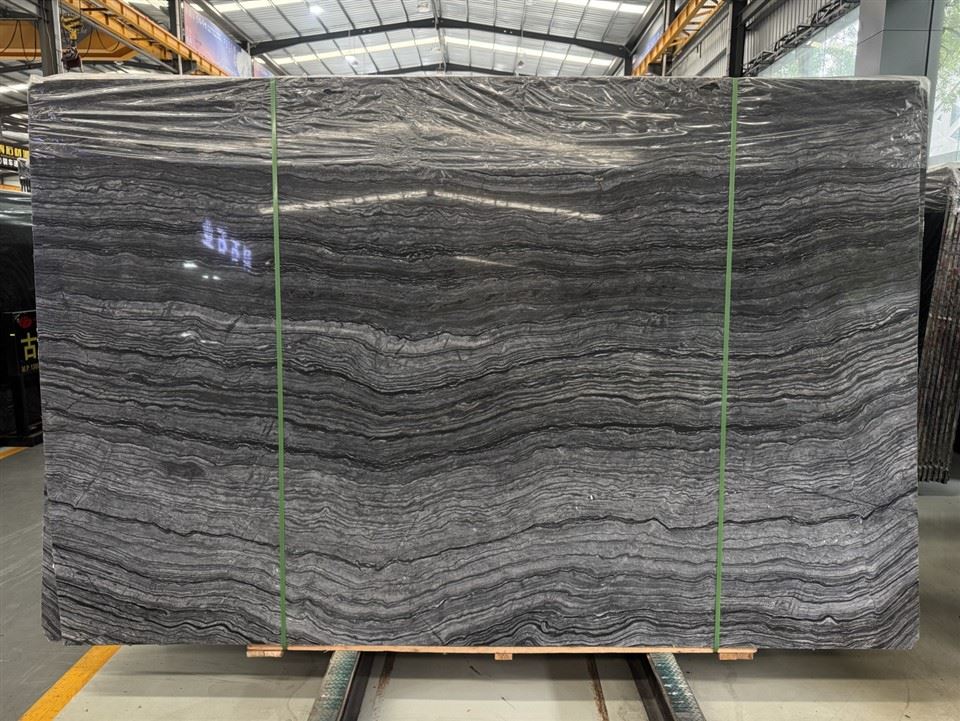

Zebra Black marble slab with layered silver-gray horizontal veining displayed at Landiview Stone factory
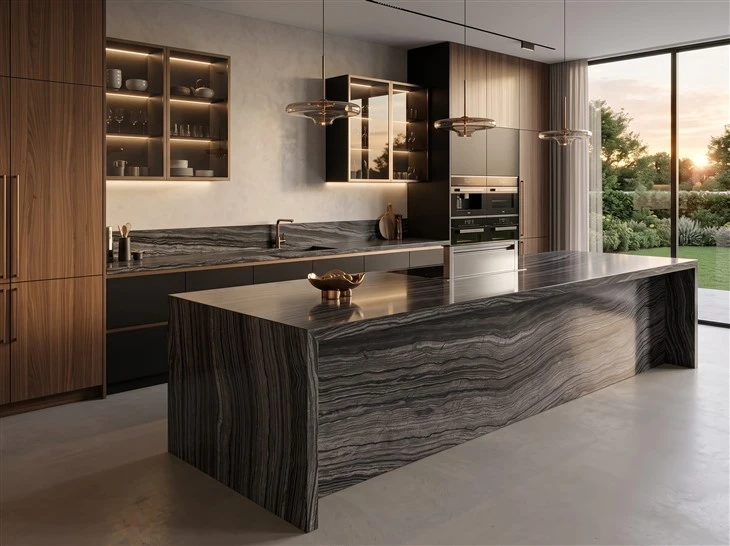
Zebra Black marble kitchen countertops and waterfall island with mitered edges in a luxury custom home
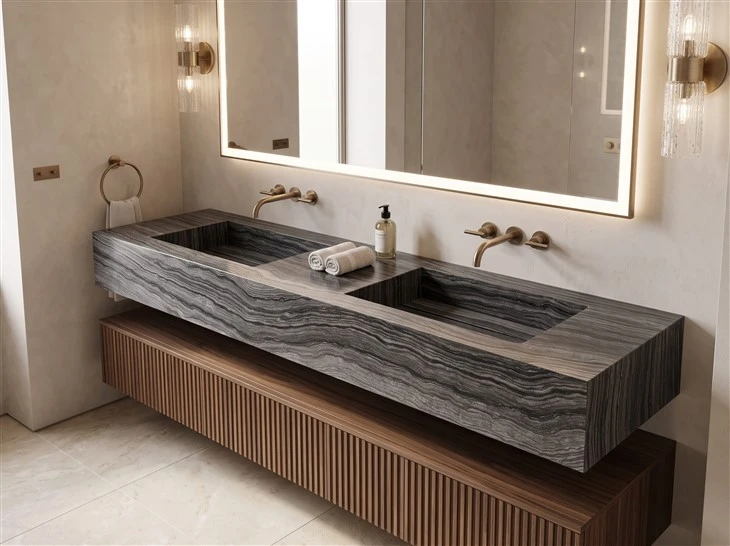
Zebra Black marble bathroom vanity top with two integrated sinks, mitered edges and warm walnut cabinetry
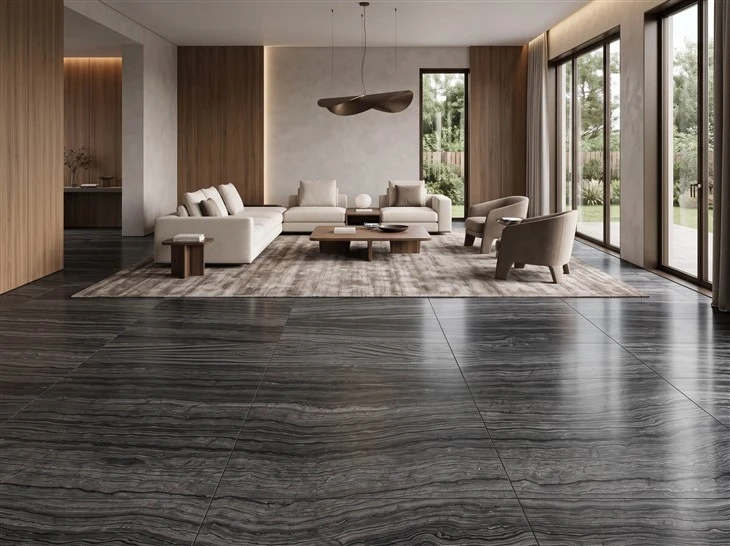
Large-format Zebra Black marble floor tiles with visible dark grout joints in a luxury custom home living room
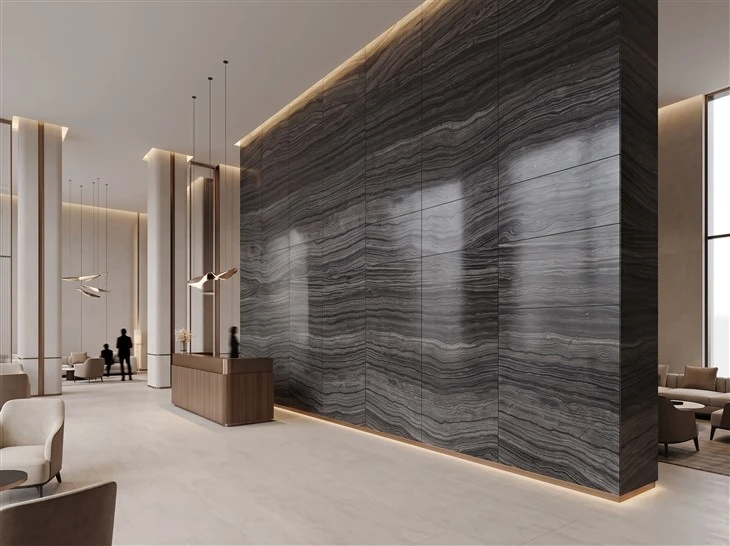
Large-format Zebra Black marble wall tiles with visible joints in a luxury hotel lobby
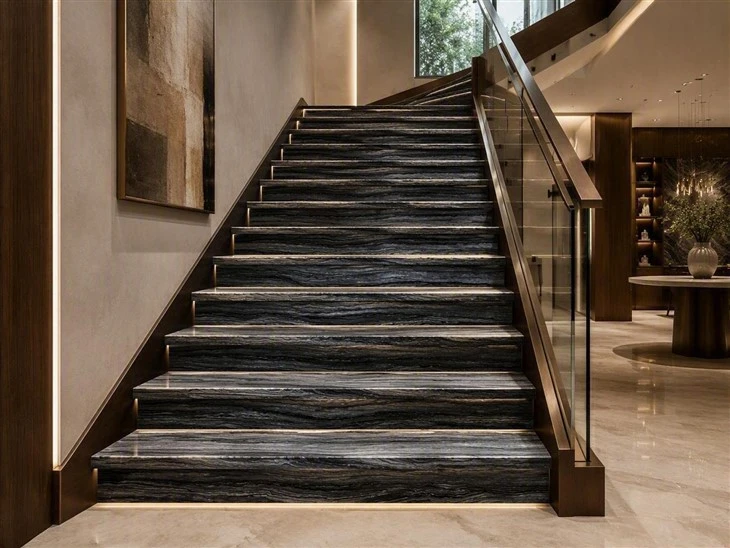
Zebra Black marble staircase treads and risers with mitered edges, glass railing and integrated step lighting
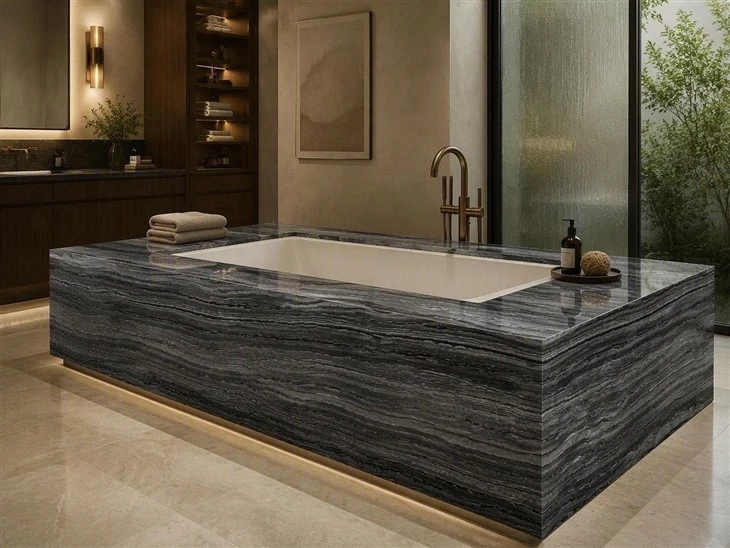
Zebra Black marble bathtub deck with mitered apron and side panels in a luxury custom bathroom
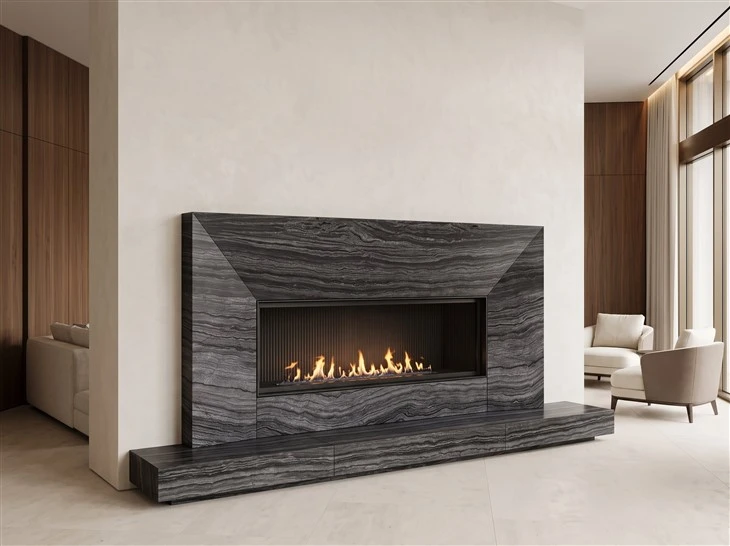
Zebra Black marble fireplace surround and hearth with mitered edges in a luxury custom home
Chinese Zebra Black Marble Slab
- Fast Delievery
- Quality Assurance
- 24/7 Customer Service
Zebra Black marble is best specified when a project needs a dark natural-stone field with strongly directional, layered movement. International buyers should approve the actual slabs, finish, thickness and vein plan rather than rely on a trade name or small sample alone.
Zebra Black marble slab is intended for slab importers, distributors, fabricators, stone contractors, interior designers, developers and builders seeking a visually directional black marble. Typical applications include kitchen islands and countertops, vanity tops, floor and wall tiles, interior staircases, stone furniture, bathtub decks and surrounds, and fireplaces.
The standard slab thickness stated for this product is 18 mm. When suitable blocks are available, 20 mm and 30 mm slabs may be specially cut to project requirements. Buyers may request current slab images or videos, slab identification and a quotation for slabs or custom fabrication. Availability, dimensions, usable yield and treatment must be confirmed for the selected lot.

Key Facts
The confirmed specification is natural marble from China, commercially sold as Zebra Black marble or Kenya Black marble. Its defining visual is a black background crossed by layered silver-gray horizontal veining; the recommended finishes are polished and honed.
| Product Attribute | Confirmed Information |
| Product name | Zebra Black marble slab |
| Alternative commercial name | Kenya Black marble |
| Material | Natural marble |
| Origin | China |
| Color and visual character | Black background with layered silver-gray horizontal veining |
| Standard slab thickness | 18 mm |
| Optional thicknesses | 20 mm and 30 mm may be specially cut from selected blocks, depending on block availability and project requirements |
| Recommended finishes | Polished and honed |
| Supply formats | Slabs and project-specific cut-to-size or finished products |
| Slab dimensions | Subject to current slab availability; request the dimensions and usable area of identified slabs |
| Thickness tolerance | Stated standard: ±1 mm; confirm the measurement method and contractual inspection criteria before ordering |
| Natural variation | Color, vein width, direction, fissures and surface characteristics vary by slab and should be approved against the current lot |
Available Finishes and Processing Options
Polished and honed are the recommended finishes. Polishing increases reflectivity and visual contrast; honing creates a lower-sheen surface. A finish sample should be approved because finish, lighting and slab mineral variation affect the perceived depth of the black field and silver-gray layers.
▌ Polished Finish
A polished surface gives the strongest contrast between the dark background and silver-gray horizontal movement. It is suited to feature islands, vanity tops, furniture, fireplace components and wall panels where reflected light supports the design. Buyers should review current polished slabs for resin, mesh, filled areas, scratches, open fissures and overall finish consistency before approval.
▌ Honed Finish
A honed finish produces a softer visual response and generally reduces strong reflections. It can suit floors, stairs, walls and restrained interiors, but the precise sheen, color depth and slip-related requirements must be assessed with a representative finish sample. For walking surfaces and wet locations, the architect and installer should select the finish and installation system according to project specifications and local requirements.
▌ Custom Processing and Vein Coordination
Depending on scope, Landiview Stone can coordinate cutting, edge finishing, mitered components, cutouts, piece numbering, dry layout and custom fabrication. After approval of stone shop drawings and actual slabs, 1:1 slab scans can be used in AutoCAD to simulate cut positions, vein direction and relationships between adjacent parts before cutting. The approved plan guides production, while a factory dry layout checks the finished pieces and helps communicate placement to the installation team.
- • Confirm visible faces, edge profiles, joint positions and vein direction on approved shop drawings.
- • Approve actual slabs rather than assuming all lots match a website image.
- • For mitered assemblies, review corner geometry, backing, support, handling and site installation responsibilities.
- • For large sink or cooktop openings, a semi-cutout may be considered when the material, geometry and site completion plan permit; retained connections and site responsibility must be documented.
- • Complex multi-part assemblies may be modeled and virtually assembled to review clearances, reinforcement and potential interference before fabrication details are finalized.
Recommended Applications
Zebra Black marble can create a continuous dark architectural language across countertops, tiles, stairs, furniture and focal features. Successful specification depends on matching the slab character, vein direction, finish, joint design, support and maintenance expectations to each use.
▌ Kitchen Island and Kitchen Countertop

The horizontal bands can form a strong linear composition across a long island or worktop, especially when slab scans are used to plan seams and waterfall returns. Marble is a calcareous stone and can etch when exposed to acids, so the buyer should accept the maintenance behavior, approve actual slabs and coordinate seams, cutouts, support and edge details. Large sink or cooktop openings require careful handling and may justify temporary reinforcement or a documented semi-cutout strategy.
▌ Bathroom Vanity Top
A vanity top uses the layered pattern at close viewing distance and may be fabricated with standard sink cutouts or as a more complex assembled product. Faucet clearance, backsplash thickness, sink template, cabinet space, joint positions and support must be checked on shop drawings. For an approximately 22-inch-deep top, Landiview Stone commonly starts design review around a 4-inch rear zone and 2.5-inch front and side margins, but every layout must be verified against the actual sink and faucet specifications.

▌ Floor Tiles

Large-format floor tiles can extend the horizontal movement through a room, while smaller modules create a more rhythmic layout. Buyers should approve tile orientation, shade range, grout-joint strategy, finish and dry layout where visual continuity matters. The design team and qualified installer must assess substrate, movement joints, lippage criteria, wet-area conditions, slip requirements, traffic and maintenance under the applicable project specification.
▌ Wall Tiles
Wall tiles or larger panels emphasize the stone's banded structure vertically or horizontally. Elevation drawings should define joint locations, piece numbers and vein orientation, particularly across feature walls. Panel dimensions, thickness, backing, anchors or setting system, substrate and building-code responsibilities must be coordinated by the project professionals; stone appearance alone does not determine a safe attachment method.

▌ Interior Staircases

Zebra Black marble can be used for treads, risers or coordinated stair cladding, where the silver-gray layers help establish direction. The stair geometry, tread finish, nosing, joints, support, edge vulnerability and slip requirements need project-specific review. Long narrow components and mitered edges require protective handling and packing; engineering and local code compliance remain with the responsible project professionals.
▌ Bathtub Deck
A bathtub deck and surround can wrap the layered veining across the top, apron and side panels. Accurate field dimensions, tub template, service access, joints, substrate, waterproofing interfaces, removable panels and mitered edges should be resolved before cutting. Natural marble in wet areas requires compatible installation materials and a maintenance plan; sealing decisions should follow the selected product manufacturer's instructions and project conditions.

▌ Fireplace

A fireplace surround, hearth or fabricated mantel can turn the horizontal veining into a concentrated focal feature. The responsible designer must assess clearances, heat exposure, substrate, attachment, local fire requirements and compatibility with the specific appliance. Vein layout can coordinate the visible components, while narrow legs, corners and projecting hearth pieces may require temporary transportation reinforcement and custom packing.
Why Choose This Stone
Choose Zebra Black marble when the design calls for natural horizontal movement rather than a uniform black surface. Its strongest purchasing advantage is not a generic performance claim; it is the ability to select real slabs and plan how their silver-gray layers will run through the finished composition.
- • Distinctive black and silver-gray layered appearance for contemporary or high-contrast interiors.
- • Directional veining that can be intentionally aligned across islands, walls, stairs and assembled features.
- • Availability as slabs and, depending on project requirements, cut-to-size or fabricated products.
- • Polished and honed finish options for different levels of reflectivity.
- • Potential for current-slab review, slab identification, AutoCAD vein-layout simulation, factory dry layout and piece numbering.
Natural features require informed approval. A fissure is a naturally occurring separation or mineral feature and is not automatically a structural crack; an open or unstable fissure may still affect handling or serviceability. Structural cracks, processing damage, chipped edges and finish defects must be evaluated separately. Landiview Stone's surface review focuses on conditions that may affect handling or fabrication, overall pattern coordination, unusually large and visually discordant black areas, and the agreed color and vein range.
Comparison with Similar Stones
Zebra Black marble should be compared by actual slab appearance, mineral category, intended use and maintenance expectations, not by color name alone. Similar dark stones can differ substantially in veining, acid sensitivity, hardness, finishing response, availability and fabrication behavior.
| Stone | Typical Visual Direction | Material Category | Typical Uses | Buyer Considerations |
| Zebra Black / Kenya Black marble | Black field with layered silver-gray horizontal veining | Natural marble from China | Countertops, vanities, floors, walls, stairs, furniture, bathtub surrounds and fireplaces | Approve current slabs, directional layout, finish, fissures, thickness and usable yield; marble can etch with acids. |
| Nero Marquina marble | Black background with contrasting white veins, often sharper and less continuously layered | Natural marble, commercially associated with Spain; verify selected source | Countertops, vanities, floors, walls and decorative features | Approve actual lot, filled areas and vein distribution; calcareous-stone maintenance expectations apply. |
| Silver Wave marble | Dark gray to black ground with flowing silver-white wave movement | Natural marble; commercial sourcing may vary and should be verified | Feature walls, floors, countertops, stairs and furniture | Can be visually close to strongly banded black marbles; compare identified slabs and tested documentation rather than names alone. |
| Via Lactea granite | Black ground with fine white linear movement | Natural granite, commercially associated with Brazil; verify selected source | Countertops, islands, walls and other interior surfaces | Generally selected as a siliceous alternative; pattern scale, finish behavior and lot data differ from marble. |
| Nero Assoluto / Absolute Black granite | More uniform black appearance with limited visible veining | Natural granite or gabbro sold under commercial black-granite names; verify source | Countertops, tiles, stairs and architectural work | Better for a uniform visual objective; review polish, color treatment and current lot consistency. |
The comparison is directional, not a substitute for samples, current slab inspection, laboratory data or project-specific professional review. Commercial stone names are not always geologically precise or exclusive to one supplier.
Frequently Asked Questions
Buyers can request samples, current slab records, slab-only supply or custom fabrication. The key risk controls are written acceptance criteria, approval of identified slabs and drawings, recorded vein layout, inspection of finished work and packing designed around the product geometry.
Q: Can you provide Zebra Black marble samples?
A: Yes. Normally one or two samples can be provided without a sample charge, with typical sizes from 100 × 100 mm to 200 × 200 mm. Courier cost is paid by the customer, and availability depends on the current material. A small sample is useful for reviewing finish, basic color family and surface character, but it cannot represent the full layered composition of a large slab. Buyers should also approve current slab photos or videos before ordering.
Q: What is your Zebra Black marble slab thickness tolerance?
A: The stated standard thickness tolerance is ±1 mm. Before ordering, the buyer should confirm the measurement method, sampling points, nominal thickness, edge conditions and acceptance criteria in the contract, approved drawings or inspection standard. Fabricated assemblies may also need coordinated substrate, support, adhesive-bed and adjacent-material tolerances; nominal slab thickness alone does not define the finished installation.
Q: How do you inspect Zebra Black marble slab surface quality?
A: Landiview Stone checks cracks that may affect handling or fabrication, overall pattern coordination, unusually large and visually discordant black patches, and color and vein variation within the buyer-approved range. The review cautiously distinguishes natural mineral movement and fissures from structural cracks, processing damage or unstable conditions. Inspection scope and acceptance criteria should be agreed before purchase because natural variation is inherent and visual expectations differ by project.
Q: Can I see current slab photos and videos before ordering?
A: Yes, subject to actual inventory. Landiview Stone can provide images or videos of the current lot, slab numbers, a surface review and an indication of the available color and vein range. Buyers should identify the slabs included in the quotation and approval record. Lighting, camera settings and screens can affect digital color, so samples or in-person inspection may be appropriate for color-critical work.
Q: Can you supply cut-to-size and finished Zebra Black marble products, not only slabs?
A: Yes. Clients first submit architectural drawings; the technical team then prepares stone shop drawings for review. Current slab images are submitted, or block selection and special slab cutting may be investigated if appropriate. After drawings and slabs are approved, slab scans are used in AutoCAD for cutting and vein-layout simulation. Following approval, the factory fabricates, dry lays, inspects, replaces nonconforming pieces where required, and assigns piece numbers. Vulnerable areas receive project-specific protection, temporary reinforcement and export packing. See how to order cut-to-size stone from China.
Q: Can Landiview Stone prepare stone shop drawings from architectural drawings?
A: Yes. The technical team can review architectural drawings, identify the stone scope and develop stone shop drawings covering relevant dimensions, thicknesses, cutouts, edges, joints, visible surfaces, finishes and fabrication details. The customer and design team must review and approve the drawings before production. Stone shop drawings do not replace the structural, waterproofing, fire-safety, code or installation responsibilities of locally licensed professionals. See what cut-to-size stone means in project supply.
Q: How do you help control the final vein layout and installed appearance?
A: After the shop drawings and actual slabs are approved, 1:1 slab scans can be placed in AutoCAD to plan cutting positions, vein direction and visual relationships. The client reviews the simulation before cutting. Factory dry layout then checks the fabricated pieces, supports replacement decisions and assigns piece numbers corresponding to installation drawings. This process reduces information gaps but cannot eliminate natural variation, camera differences, fabrication tolerances or the effect of site installation. See natural stone slab layout in AutoCAD.
Q: How do you protect Zebra Black marble slabs and finished stone during shipping?
A: Slabs use robust export supports selected for the actual container plan, such as a suitable wooden slab frame or an A-frame and enclosure arrangement. Finished products may use liners, shock-absorbing materials, custom foam, plywood separators, edge protection and positioning supports. Sink or cooktop cutouts, narrow backsplashes, thin strips, vanity tops, fireplace parts, narrow wall panels and vulnerable corners may receive temporary support strips over protective film; installers remove the supports before final installation. Regulated raw-wood packaging should use ISPM 15-compliant material as required by the destination. [3][4] See how Landiview Stone protects natural stone during shipping.
Q: How should installed Zebra Black marble be maintained?
A: Use a pH-neutral cleaner intended for natural stone, blot spills promptly, rinse as directed and avoid unidentified acidic or alkaline cleaners and abrasive tools. Marble is calcareous and can be affected by acidic solutions. The need for a penetrating sealer, product compatibility and reapplication interval depend on the stone, finish, exposure, traffic and sealer manufacturer's instructions; test products in an inconspicuous area and follow the project maintenance specification. [2]
Q: Is Zebra Black marble suitable for kitchen countertops?
A: It can be specified for kitchen islands and countertops when the buyer accepts marble's maintenance behavior and the design addresses support, seams, cutouts and edge protection. Acidic foods and cleaners can etch calcareous marble, and spills should be handled promptly. Approve actual slabs and a finish sample, and use qualified fabricators and installers. For hard-use kitchens where acid resistance is a primary requirement, compare appropriate siliceous stones or other materials before deciding.
Q: Is Zebra Black marble the same as Kenya Black marble?
A: Kenya Black marble is another commercial name used for this Zebra Black marble product. Trade names can be shared, translated or applied differently in the market, so the name alone should not be the acceptance standard. The purchase record should identify the approved material, China origin, actual slab numbers, thickness, finish, images or samples, and agreed quality criteria.
Q: What information is needed for a Zebra Black marble quotation?
A: Send the required slab or finished dimensions, nominal thickness, quantity, finish, application and delivery destination. For fabricated work, include architectural drawings, templates, visible-face requirements, edge details, cutouts, joints and desired vein direction. Pricing depends on current slab or block availability, usable yield, selection, thickness, finish, fabrication complexity, dry layout, replacement allowance, packing and logistics. Quotations should be compared against the same approved scope rather than headline square-metre price alone.
Q: Can you supply 20 mm or 30 mm Zebra Black marble slabs?
A: Potentially yes. The standard slab thickness stated for this product is 18 mm, while 20 mm and 30 mm slabs may be specially cut from selected blocks according to customer requirements. This is subject to suitable block availability, production planning, minimum practical cutting scope and confirmation of the resulting slab dimensions, yield, treatment and lead time. Request current feasibility before specifying the optional thickness as fixed supply.
Q: What should buyers confirm before releasing a slab order?
A: Confirm the actual slab numbers, dimensions, usable area, thickness and tolerance criteria, finish, visual range, surface condition, resin or mesh treatment if any, quantity, packing method, destination requirements and acceptance records. For fabricated orders, also approve shop drawings, cut positions, vein layout, visible faces, joints, cutouts, edge details, piece numbering and installation responsibilities. Large slabs are heavy and require trained handling procedures and suitable equipment at unloading and storage locations. [4]
Why Landiview Stone
Landiview Stone supports two B2B purchasing paths: identified slabs for importers, distributors and fabricators, and project-specific cut-to-size or finished stone for contractors, developers, designers, builders and other project buyers. The workflow is adjusted to the actual stone, geometry, route, site conditions and approved specification.
▌ Support for Slab Buyers
For slab orders, Landiview Stone can support current slab selection, slab-image review, confirmation of the available color and vein range, surface inspection, slab identification and export packing. The objective is to connect the commercial order to identified material rather than treating the trade name as sufficient visual approval.
▌ Workflow for Custom Fabrication
- 1. Review architectural drawings and identify the stone scope.
- 2. Prepare stone shop drawings for client and design-team approval.
- 3. Submit available slabs; if unsuitable, investigate block selection and special slab cutting when appropriate.
- 4. Use approved slab scans in AutoCAD to simulate cutting and vein layout before production.
- 5. Fabricate to approved documents, then dry lay, inspect and number finished pieces.
- 6. Replace nonconforming pieces when required while considering adjacent color and veining.
- 7. Apply project-specific protection, including temporary reinforcement for vulnerable geometry, before export packing.
For more complex fabricated and assembled products, the project team may use three-dimensional modeling and virtual assembly review to examine component relationships, material thicknesses, surface treatments, concealed reinforcement and potential interference before fabrication details are finalized. AutoCAD layout planning and factory dry layout serve different purposes: the first plans intended cuts; the second checks the actual fabricated composition.
▌ Selected International Project Experience
- • Marble furniture, bathroom vanity tops and shower wall panels for the Grand Hyatt Singapore renovation project
- • Stone supply for stations on Singapore's Thomson-East Coast Line
- • Interior stone products for the Wynn project in the United Arab Emirates
- • Marble products for public areas of the 255 East 77th Street luxury residential project in New York
- • Interior and exterior marble and granite products for three high-end custom homes on Tuckahoe, a private resort island in Massachusetts, USA
Request A Quote
For an actionable quotation, identify whether you require slabs or finished stone and provide dimensions, thickness, quantity, finish, application and destination. Drawings and templates allow the technical team to evaluate yield, joints, cutouts, vein direction, packing and fabrication scope more accurately.
Looking for Zebra Black marble slabs, also sold as Kenya Black marble, or custom cut-to-size products? Send Landiview Stone the required sizes, thickness, quantity, finish, intended application and delivery destination. Include architectural drawings, stone schedules, templates or reference details when available.
Subject to current material availability, the reply can include identified slab dimensions, slab photos or videos, available visual range and a project-specific quotation. For fabricated work, the proposed scope may also include stone shop drawings, slab-scan vein-layout planning, factory dry-lay inspection, piece numbering, temporary transportation reinforcement and export packing.
Request A Project Quote Or Slab Availability
Hot Tags: Zebra Black marble slab, Kenya Black marble, black marble supplier, China marble slab, custom marble fabrication, Landiview Stone
Previous
No InformationYou Might Also Like




Send Inquiry