


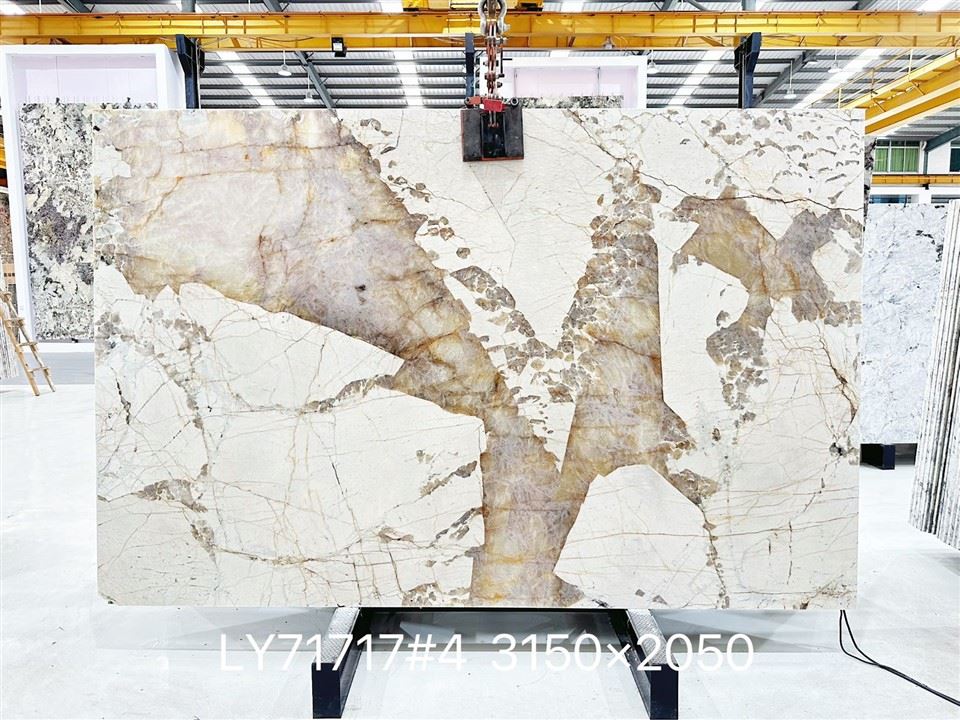

Patagonia Quartzite slab with an ivory-white background, champagne-beige crystal formations and natural brown veining.
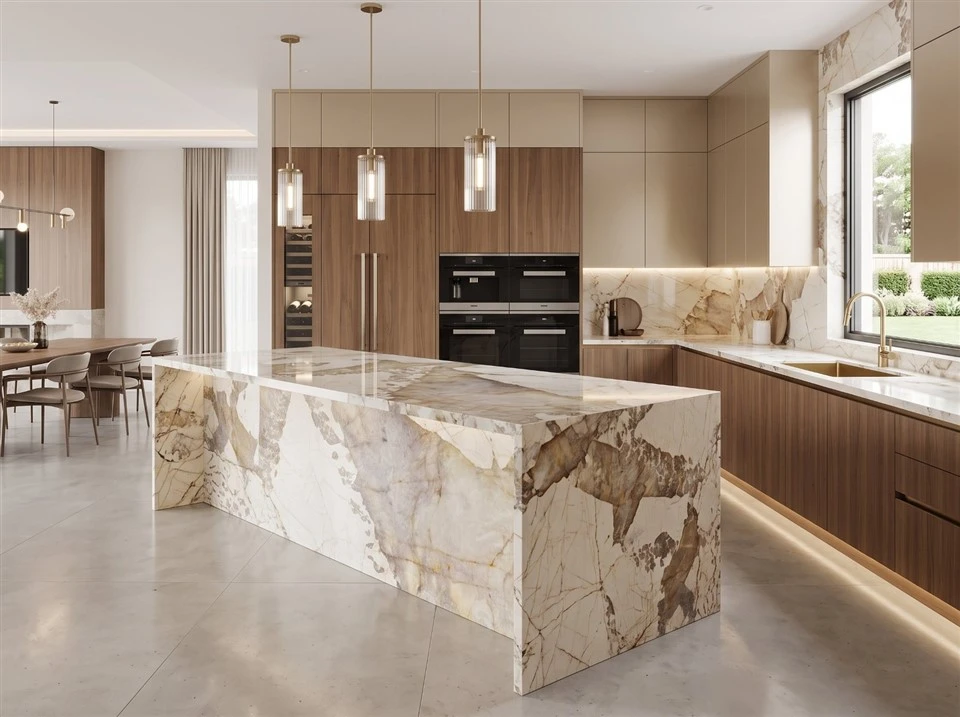
Luxury kitchen featuring Patagonia Quartzite countertops and a large waterfall island with warm wood cabinetry.
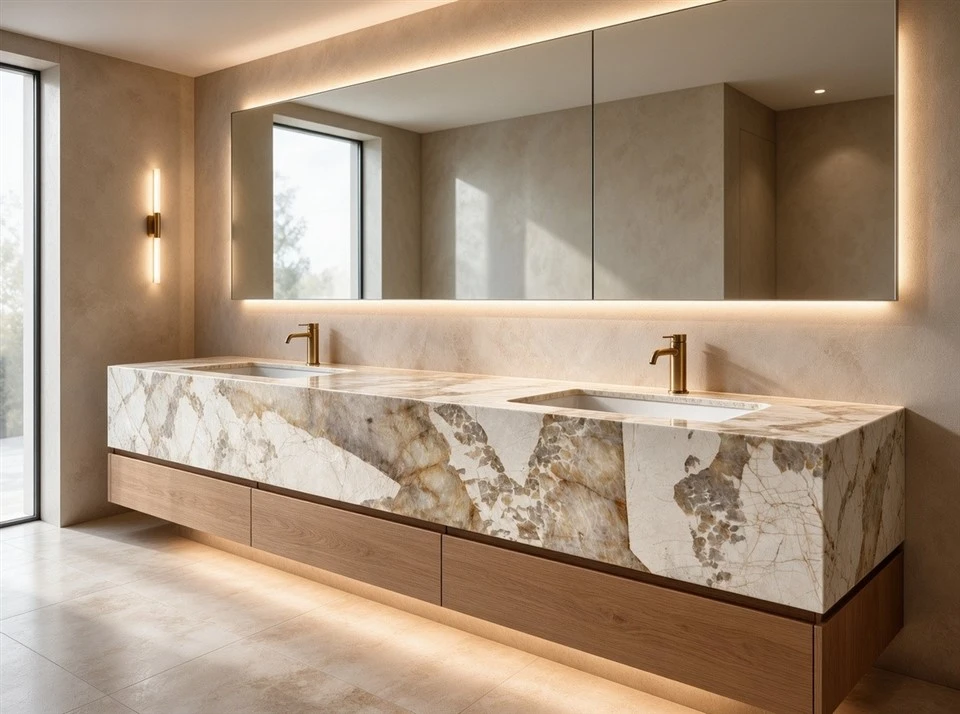
Luxury floating bathroom vanity with a Patagonia Quartzite double-sink top, warm wood cabinetry and brass faucets.
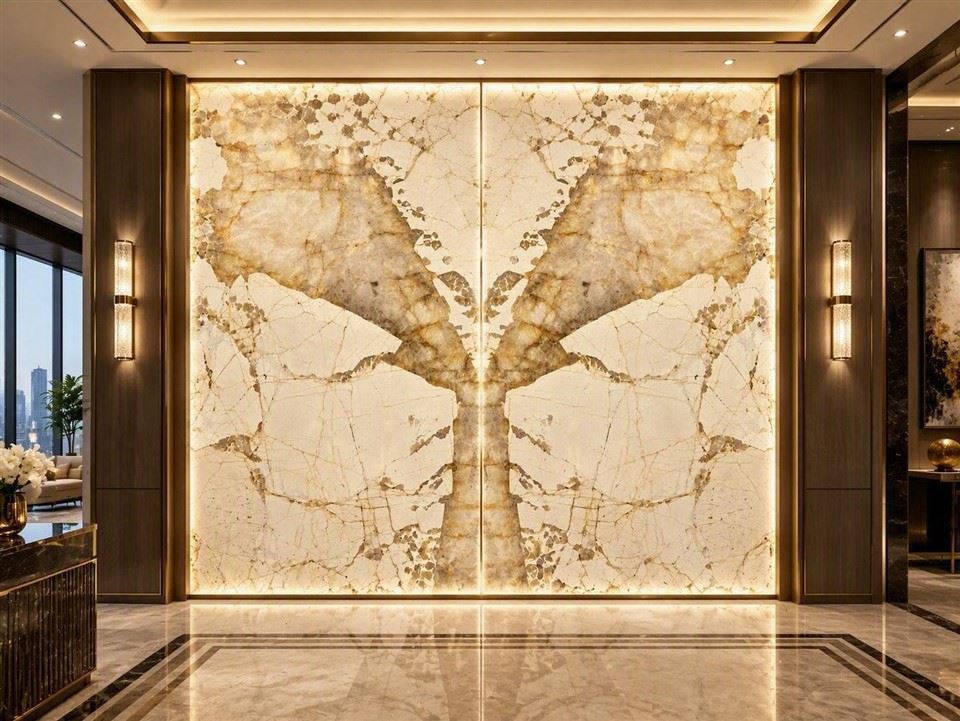
Backlit Patagonia Quartzite feature wall with two symmetrical book-matched panels and a visible central joint in a luxury interior.
Brazilian Patagonia Quartzite Slab
- Fast Delievery
- Quality Assurance
- 24/7 Customer Service
Executive Summary
Patagonia Quartzite is a Brazilian natural quartzite selected for high-visibility interiors where an ivory-white field, champagne-beige crystal formations and brown veining become part of the composition. It is available from Landiview Stone as slabs for importers and fabricators or as project-specific finished stone for qualified commercial and residential work.
At a standard slab thickness of 20 mm, subject to confirmation for the current lot, Patagonia Quartzite is recommended for kitchen islands and countertops, bathroom vanity tops, and feature walls. Polished and honed are the recommended finishes. Large translucent crystal zones may be evaluated for backlighting, but light transmission and visual uniformity must be reviewed against the actual slab, cut location, backing, lighting system and installation build-up. Buyers should submit dimensions, quantity, finish, application, destination and available drawings so slab suitability, usable yield, fabrication scope and packing can be assessed.

Key Facts
The confirmed product specification is natural quartzite from Brazil, with a 20 mm standard slab thickness, an ivory-white background, champagne-beige crystal formations and natural brown veining. Polished and honed finishes are recommended. Current dimensions, treatment, quantity and exact appearance require lot-specific confirmation.
| Product Attribute | Confirmed or Buyer-Check Information |
| Product name | Patagonia Quartzite slab |
| Material | Natural quartzite |
| Origin | Brazil |
| Color and visual character | Ivory-white background with champagne-beige crystal formations and natural brown veining. Pattern scale, crystal distribution, fissures and tone vary naturally from slab to slab. |
| Standard slab thickness | 20 mm |
| Stated thickness tolerance | ±1 mm. The measurement method and project acceptance criteria should be written into the contract, drawings or inspection standard before ordering. |
| Recommended finishes | Polished and honed |
| Backlighting potential | Large translucent crystal areas can transmit light and may be used in a backlit composition. The actual effect is location-specific and must be tested with the selected slab and proposed lighting assembly. |
| Recommended applications | Kitchen island and kitchen countertop; bathroom vanity top; feature wall, including evaluated backlit panels. |
| Supply forms | Slabs for importers, distributors and fabricators; project-specific cut-to-size or finished products for contractors, developers, designers, builders and other project buyers. |
| Availability and commercial terms | Current slab sizes, quantities, surface treatment, finish, MOQ, lead time and price are available upon request and subject to current material and project scope. |
ASTM C616/C616M-22 publicly describes the scope, material characteristics, physical requirements and sampling relevant to quartz-based dimension stone; no Patagonia Quartzite test value is inferred from that public abstract. Project-specific performance should be supported by current and applicable documentation when required. [1]
Available Finishes and Processing Options
Choose polished when the design calls for stronger color depth, crystal definition and light reflection. Choose honed for a softer, lower-sheen reading. For either finish, approve a representative sample and current slab images because finish, resin treatment, mineral structure and lighting can change the perceived color and contrast.
▌ Polished Finish
A polished finish usually gives the clearest reading of the champagne-beige crystal zones, ivory-white areas and brown veining. It suits statement kitchen islands, countertop focal areas and feature walls where reflected light is part of the design. Buyers should inspect the selected slabs under relevant lighting and confirm the acceptable level of gloss, fill, resin visibility, mesh backing and surface reflection. A polished surface does not remove natural fissures or make narrow edges immune to chipping.
▌ Honed Finish
A honed finish reduces surface reflection and can create a quieter, more tactile appearance. The lower sheen may soften contrast and make crystal areas read differently from a polished control sample. For countertops and vanity tops, the buyer should review how the proposed honing process affects color, fingerprint visibility, cleaning expectations and the appearance of any resin or filled areas. Finish approval should be based on the same material range intended for production.
▌ Backlighting and Custom Processing
Patagonia Quartzite contains large translucent crystal formations, so selected slab zones can be evaluated for backlighting. A successful result depends on more than the stone name: crystal position, remaining stone thickness, backing, adhesive system, light-source spacing, access for maintenance, ventilation and the distance between the light plane and stone all influence the installed appearance. Mock-ups are recommended before final fabrication. Electrical, support and attachment design must follow project specifications, local requirements and qualified professional guidance.
- • Available processing may include cut-to-size panels, finished edges, cutouts, slab scanning, vein-layout planning, dry layout and piece numbering, depending on project requirements.
- • Book-matched or symmetrical compositions depend on the availability and relationship of suitable sequential slabs; the intended center joint and viewing orientation should be shown in approved drawings.
- • Large cutouts, narrow strips, thin bridges and crystal-rich transitions require geometry-specific fabrication, handling and transport review.
Recommended Applications
Patagonia Quartzite is most effective where the project can allocate large visual areas to the natural slab composition. Kitchen islands, countertops, vanity tops and feature walls are recommended, but each application requires its own slab-selection, joint, support, cutout, edge, lighting and maintenance decisions.
▌ Kitchen Islands and Countertops
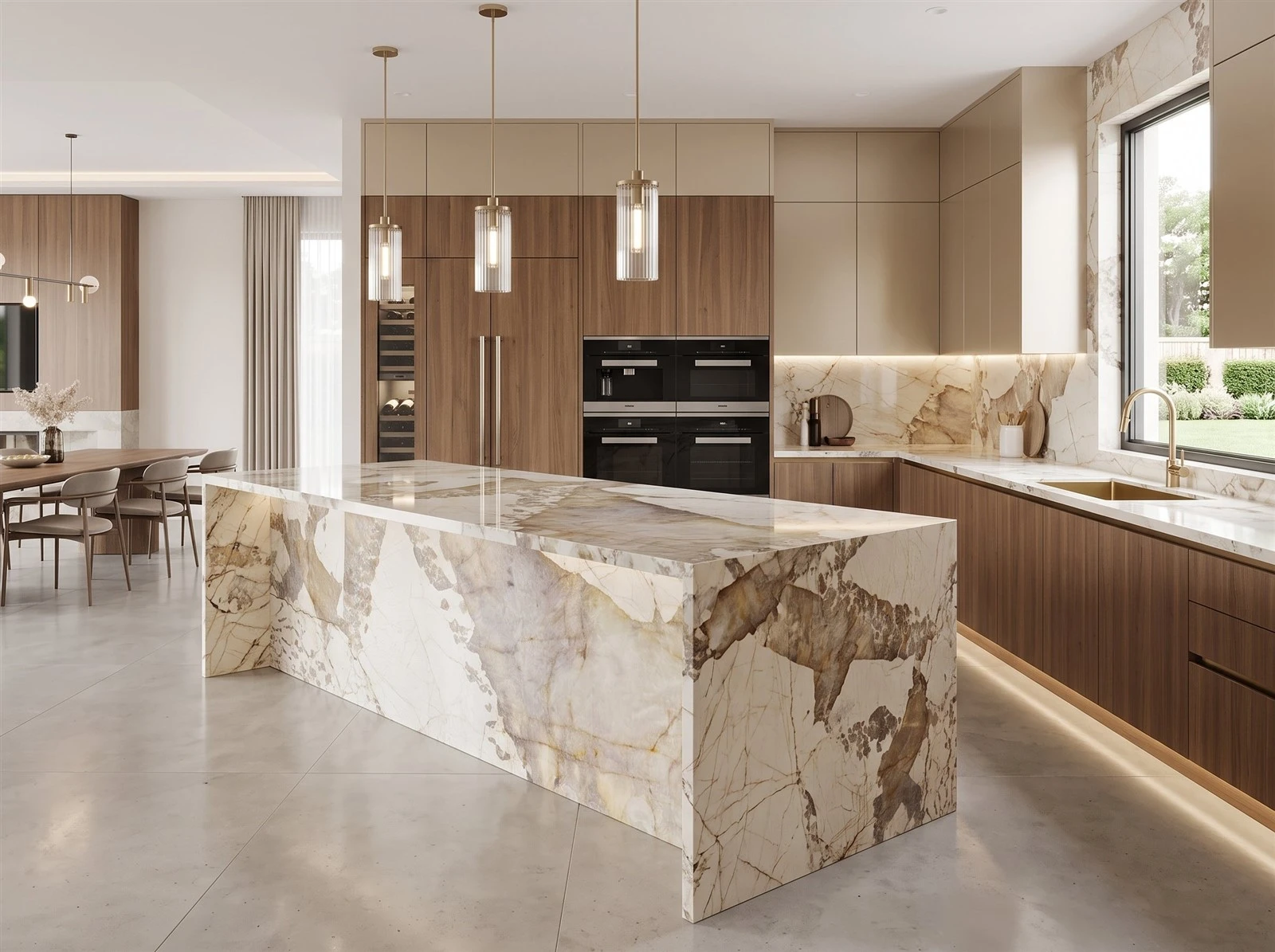
A large island can preserve a broad section of the slab's ivory-white field, champagne crystal masses and brown movement, while a waterfall end can continue selected features across a vertical return. During selection, buyers should assess the relationship between the slab pattern and the island footprint, seam locations, edge build-up, overhangs, sink or cooktop positions and required usable yield. A digitally planned layout can help reserve visually important areas for the most prominent surfaces.
Natural quartzite is used for worktops because quartz-rich stone can offer useful wear and scratch resistance, but hardness does not prevent edge chipping, impact damage, fissure-related breakage or transport risk. Large sink and cooktop openings require careful bridge-width and support review. When material and site conditions permit, a semi-cutout may leave selected connections intact for transport and be completed on site by the installation team. The retained areas and site responsibility must be shown in approved documents. Hot items, cutting practices, supports, seams and installation remain subject to project requirements and professional fabricator guidance.
▌ Bathroom Vanity Tops
Patagonia Quartzite can create a coordinated vanity top in light-toned luxury bathrooms, with crystal formations used as an intentional focal point rather than treated as random background. Selection should consider basin type, faucet reach, backsplash, wall condition, cabinet support, edge profile and the position of openings relative to fissures and crystal transitions. For a nominal 22-inch-deep bathroom countertop, Landiview Stone's internal starting preference is a 4-inch rear zone and 2.5-inch zones at the front and side of the opening, corresponding to a maximum 13-inch sink-opening depth; where space is limited, the rear zone is preferably reduced first to 3.5 inches. These are coordination starting points only and must be checked against the actual sink template, faucet specification, spout reach, backsplash and cabinet interior.
Integrated-sink or multi-component designs may require three-dimensional modeling and virtual assembly review to examine stone thickness, joint relationships, concealed reinforcement and internal clearances before production details are finalized. Waterproofing, substrate, support and plumbing coordination remain the responsibility of the relevant project professionals and installers.

▌ Feature Walls and Backlit Panels

Feature walls allow the large-scale mineral composition to be read from a distance. The design team should approve panel divisions, joint width, vein direction, crystal location, edge visibility, anchoring concept and viewing orientation before cutting. If two panels are intended to form a symmetrical book-matched composition, the centerline, mirrored relationship and visible central joint should be documented rather than assumed from a generic material sample.
Backlighting can reveal the translucent crystal areas, but denser stone zones may transmit less light and create contrast. The lightbox depth, illumination density, service access, heat management, stone support, backing materials and attachment method should be coordinated as one system. A full-size or representative mock-up is the safest way to evaluate hotspots, shadow lines, joints and color shift. Attachment and installation decisions should be made to the governing project specification and qualified local professional requirements.
Why Choose This Stone
Choose Patagonia Quartzite when the project needs a natural, large-scale composition rather than a uniform repeat. Its value comes from the relationship between pale areas, champagne crystal formations, brown veining and selected translucent zones. The strongest result depends on approving actual slabs and planning cuts around the architecture.
- • Distinctive natural composition: the ivory-white background, champagne-beige crystals and brown veins create a layered visual structure suitable for statement surfaces.
- • Backlighting potential: large translucent crystal areas can become part of a controlled illuminated feature after slab-specific testing.
- • Multiple focal applications: the same material can coordinate a kitchen island, countertop, vanity top or feature wall when the quantity and slab range are planned together.
- • Digital layout opportunity: full-slab scans can support cutting and vein-layout simulation before physical production, helping align approved piece positions with the intended composition.
- • Natural variation with traceability: slab numbers, current images, videos and inspection records can help buyers define the approved range without pretending that every slab is identical.
The buyer should not select this material from a small sample alone. A sample can help assess finish, color family and surface character, but it cannot represent the full pattern, crystal scale, fissure distribution or yield of a large slab. For specification-critical work, confirm current slab dimensions, thickness, treatment, surface condition, applicable test documentation and fabrication assumptions before contract approval.
Comparison with Similar Stones
Patagonia Quartzite is better compared by actual slab composition than by color label alone. Cristallo-type quartzites may emphasize translucency, Taj Mahal-type quartzites usually present a calmer warm field, and engineered quartz offers greater pattern repeatability. Commercial names vary, so material identity and performance documentation should be confirmed for the selected lot.
| Stone | Typical Visual Direction | Material Category | Typical Uses | Buyer Considerations |
| Patagonia Quartzite | Ivory-white background, champagne-beige crystal formations and natural brown veining; selected crystal zones may transmit light. | Natural quartzite, subject to lot-specific verification | Kitchen islands, countertops, vanity tops and feature walls | Approve actual slabs, crystal placement, fissures, usable yield, thickness, treatment, matching plan and any backlighting mock-up. |
| Cristallo-type quartzite | Often selected for pale crystalline fields and potentially translucent zones, with movement varying by lot. | Commercially traded natural quartzite; verify geological identity and project documentation | Backlit walls, counters, bar fronts and decorative panels | Translucency is not uniform. Review thickness, backing, lighting arrangement, fissures and available slab sequence. |
| Taj Mahal-type quartzite | Typically a calmer warm cream-to-beige field with softer linear movement than Patagonia's fragmented crystal composition. | Commercially traded natural quartzite; verify the selected lot | Countertops, islands, vanity tops and wall applications | Useful where visual continuity is preferred over strong crystal contrast. Confirm color range, finish and actual slab identity. |
| Light calcitic or dolomitic marble | Pale backgrounds with clouding or veining, generally without the same quartz-rich crystal composition. | Calcareous natural stone | Vanities, wall panels, decorative furniture and selected counters | Acid sensitivity and etching behavior differ from siliceous quartzite. Match maintenance expectations to the actual stone and use. |
| Engineered quartz | More controlled color and repeatability, depending on manufacturer and design. | Manufactured composite surface, not natural quartzite | Interior countertops and vanity tops within manufacturer limitations | Review manufacturer requirements for heat, UV exposure, slab size, seams, warranty and fabrication. It does not reproduce one-of-a-kind natural slab geology. |
ASTM's public abstract distinguishes quartz-based dimension stone from molded, cast or artificially aggregated units, which is relevant when buyers compare natural quartzite with manufactured composite surfaces. [1]
Frequently Asked Questions
Before ordering, buyers should confirm the current slabs, approved visual range, usable dimensions, thickness and tolerance, finish, fabrication scope, inspection method, packing design and destination requirements. The answers below explain Landiview Stone's normal coordination approach; final terms remain subject to the selected material and written order documents.
Q: Can you provide Patagonia Quartzite samples?
A: Yes. Normally one or two samples can be provided without a sample charge, with typical sizes from 100 × 100 mm to 200 × 200 mm. Courier cost is paid by the customer, and availability depends on the current material. A small sample is useful for reviewing finish, approximate color family and surface character, but it cannot represent the full crystal formations, brown veining, natural fissures or usable yield of a large slab. For final selection, review current slab images or video and identify the approved slabs.
Q: What is your Patagonia Quartzite slab thickness tolerance?
A: The stated standard thickness tolerance is ±1 mm. Before ordering, the buyer and supplier should confirm the measurement method, sampling locations, treatment of local surface variation and the acceptance standard in the contract, approved drawings or inspection criteria. A nominal 20 mm slab should not be interpreted as an assurance that every point is exactly 20 mm. Fabricated edge build-ups, joints, support levels and adjoining materials should be coordinated with the approved project tolerance.
Q: How do you inspect Patagonia Quartzite slab surface quality?
A: Inspection focuses on cracks that may affect handling or fabrication, overall pattern coordination, unusually large black areas that fall outside the agreed visual range, and color and vein variation against the buyer's approval. Natural characteristics must be distinguished carefully from defects that may affect use. Crystal boundaries, mineral variation, fissures, resin or mesh treatment and filled areas should be documented rather than automatically classified as damage. Acceptance criteria should reflect the selected slabs, intended cuts, finish and project requirements.
Q: Can I see current slab photos and videos before ordering?
A: Yes, subject to actual stock. Landiview Stone can provide current-lot slab images or videos, slab numbers, surface-review information and confirmation of the available color and pattern range. Buyers should identify which slabs are approved and record any important orientation or exclusion zones. Digital images are helpful for remote review, but screen color, camera settings and lighting can alter appearance. When color is critical, combine images with samples, written acceptance criteria and, where practical, video review under consistent lighting.
Q: Can you supply cut-to-size and finished products, not only slabs?
A: Yes. The normal workflow starts with the client's architectural drawings. Landiview Stone develops stone shop drawings for review, submits current slab images and, if current slabs are unsuitable, may investigate block selection and special slab cutting depending on project requirements. After shop drawings and slabs are approved, slab scans are used in AutoCAD for cutting and vein-layout simulation. Following layout approval, the factory fabricates, dry lays and inspects the pieces, replaces nonconforming work when required, applies piece numbers, protects vulnerable areas and prepares export packing. See how to order cut-to-size stone from China.
Q: Can Landiview Stone prepare stone shop drawings from architectural drawings?
A: Yes. The technical team can review architectural drawings, identify the stone scope and prepare stone shop drawings showing dimensions, thicknesses, cutouts, edge work, visible surfaces, finishes, joints, reinforcement and related fabrication information. The client and relevant design team must review and approve the drawings before production. Stone shop drawings coordinate fabrication; they do not replace the structural, waterproofing, electrical, code or installation responsibility of locally licensed professionals. See what cut-to-size stone means for a project order.
Q: How do you help control the final vein layout and installed appearance?
A: After the shop drawings and slabs are approved, full-slab scans can be placed in AutoCAD to simulate cuts, piece positions, vein directions and relationships between adjoining components. The buyer reviews the proposed layout before cutting. After fabrication, factory dry layout compares the actual pieces, supports replacement decisions and enables piece numbering linked to installation drawings. This reduces information loss, but it cannot remove natural variation or control every site-installation factor. Read about natural stone slab layout in AutoCAD.
Q: How do you protect slabs and finished stone during shipping?
A: Slab packing is designed for the actual load and may use a strong export wooden crate or an A-frame/support arrangement. High-value or fissure-rich slabs such as Patagonia Quartzite may use a steel A-frame with cushioning, slab separation and an enclosed plywood outer package where appropriate. Finished products may receive liners, shock absorption, custom foam, dividers, plywood support and edge protection. Sink or cooktop cutouts, narrow backsplashes, strips, vanity tops, fireplace parts, narrow wall panels and fragile corners may receive removable support strips over protective film. Wood packaging must be assessed for destination-country and ISPM 15 requirements. [2][3] See how to protect natural stone during shipping.
Q: How should installed Patagonia Quartzite be maintained?
A: Use a pH-neutral cleaner intended for natural stone, respond promptly to spills and avoid unidentified acidic or alkaline chemicals and abrasive tools. The Natural Stone Institute advises understanding the stone's composition, using neutral cleaner or stone soap, following product directions, rinsing and drying the surface, and avoiding acidic cleaners even on siliceous stones. [4] Sealer selection and reapplication frequency depend on the stone, finish, use, exposure and sealer manufacturer's instructions. Test maintenance products in an inconspicuous area and follow the project specification and professional installer guidance.
Q: Can Patagonia Quartzite be used for a backlit feature wall?
A: Yes, selected large crystal areas can transmit light and make Patagonia Quartzite suitable for evaluated backlit features. The effect is not uniform across the entire slab, so the proposed panel positions should be tested against the actual slab. A mock-up should coordinate stone thickness, backing, adhesive, light spacing, lightbox depth, service access, heat management, joints and attachment. Denser areas may remain darker, and this contrast should be accepted as part of the approved composition rather than treated as an installation surprise.
Q: Is Patagonia Quartzite suitable for kitchen countertops?
A: It can be suitable for kitchen countertops when the selected slabs, geometry, supports and fabrication details meet the project requirements. Quartz-rich natural stone is valued for wear and scratch resistance, but hardness does not eliminate edge chipping, breakage, staining, impact or transport risks. Confirm sink and cooktop bridge widths, seams, overhang support, edge details, resin or mesh treatment and maintenance expectations. For large openings, a semi-cutout may be considered when agreed in the shop drawings and completed safely on site by the responsible installer.
Q: What affects the price of Patagonia Quartzite slabs or finished products?
A: Pricing is project-specific. For slabs, important variables include current availability, dimensions, thickness, visual selection, usable yield, finish, treatment, quantity, packing and destination logistics. For finished work, cutting complexity, edge work, cutouts, matching, shop drawings, slab scanning, dry layout, reinforcement, replacement allowance and packing also matter. Buyers should compare quotations against the same approved slabs, scope, quality criteria and delivery terms rather than comparing only a square-metre figure. Send drawings and a destination for a meaningful quotation.
Q: What information should I send for a Patagonia Quartzite quotation?
A: Send the required supply form, dimensions, nominal thickness, quantity, finish, application and delivery destination. For fabricated work, include architectural drawings, stone schedules, elevations, details, edge profiles, cutout templates, joint preferences and any required inspection or testing criteria. For backlit work, include panel sizes, intended pattern relationship and available lighting or support information. Landiview Stone can then check current slab availability, likely yield, technical questions, fabrication scope and packing assumptions. Missing information can be listed as a quotation exclusion or item requiring later confirmation.
Q: How are natural fissures different from structural cracks or fabrication defects?
A: Natural fissures are geological features formed within the stone, while a structural crack or unstable opening may affect integrity, and a fabrication defect results from production damage or work outside the agreed requirements. The distinction cannot be made reliably from terminology alone. Inspect the feature's continuity, openness, movement, location, treatment and relationship to the intended cut. Crystal-rich Patagonia slabs may also contain mesh, resin or filled zones. Acceptance should be based on the selected slab, fabrication risk and written criteria, not on a blanket rule that every line is acceptable or defective.
Why Landiview Stone
Landiview Stone supports two buyer paths: slab supply for importers, distributors and fabricators, and project-specific cut-to-size or finished stone for contractors, developers, designers and builders. Its practical value is the connection between approved information, digital layout, fabrication inspection, piece identification and transport protection.
▌ Support for Slab Buyers
For slab buyers, Landiview Stone supports current slab selection, slab-image review, color and vein-range confirmation, surface inspection, slab identification and export packing. Current quantities, dimensions, treatments and finish availability are confirmed against actual material rather than assumed from a product name. High-value or vulnerable slabs can be evaluated for steel A-frame support, cushioning, slab separation and enclosed plywood protection; ordinary slabs may use an open wooden slab frame with a load-bearing base, inclined supports, connecting timbers, metal reinforcement, separation materials and restraints, depending on the load and container plan.
▌ Workflow for Custom-Fabricated Stone
- 1. Review architectural drawings and identify the stone scope.
- 2. Prepare stone shop drawings for client and design-team approval.
- 3. Submit available slabs; if unsuitable, investigate block selection and special slab cutting when appropriate.
- 4. After slab and drawing approval, use actual slab scans in AutoCAD to simulate cutting positions, vein direction and visual relationships.
- 5. Obtain layout approval and fabricate to the approved documents.
- 6. Dry lay finished pieces to inspect workmanship, compare the actual composition and identify any required replacement.
- 7. Assign piece numbers linked to installation information so location, orientation and adjacency are clear.
- 8. Apply project-specific surface protection, temporary reinforcement and export packing for vulnerable geometry.
Factory dry layout is not a duplicate of digital layout. AutoCAD plans where pieces should be cut; dry layout shows the actual fabricated pieces together. The latter helps identify chips, processing damage, open or unstable features, unacceptable visual differences and areas outside agreed criteria. It also helps select a replacement that coordinates with adjacent color and veining, then communicate the approved composition through numbering.
▌ Complex Product Coordination
For more complex fabricated and assembled stone products, individual components may be modeled and virtually assembled in Autodesk Inventor or SolidWorks. The project team can review component relationships, material thicknesses, surface treatments, concealed reinforcement, internal clearances, cutout positions and potential interference before fabrication details are finalized. The coordinated assembly can then inform plans, elevations, sections and shop-drawing details.
Fragile finished pieces may receive protective film followed by temporary support strips over the film at large openings, narrow edges, long sections or vulnerable corners. Internal packing can include custom foam, plywood separation, support, edge protection and positioning elements. External solid-wood crates are designed to support forklift handling, container loading, ocean transport and unloading. The exact design must suit the geometry, weight, route and destination. OSHA's advisory bulletin reinforces the broader need for trained procedures and hazard controls when stone slabs are handled, stored, loaded or unloaded. [3]
▌ Selected International Project Experience
- • Marble furniture, bathroom vanity tops and shower wall panels for the Grand Hyatt Singapore renovation project
- • Stone supply for stations on Singapore's Thomson-East Coast Line
- • Interior stone products for the Wynn project in the United Arab Emirates
- • Marble products for public areas of the 255 East 77th Street luxury residential project in New York
- • Interior and exterior marble and granite products for three high-end custom homes on Tuckahoe, a private resort island in Massachusetts, USA
Request A Quote
For a useful Patagonia Quartzite quotation, send the required supply form, dimensions, nominal thickness, quantity, finish, application and delivery destination. Include architectural drawings, stone schedules or templates when the inquiry involves cut-to-size or finished products.
Landiview Stone can check current slabs and provide available slab photos, videos and identification details, subject to actual stock. For custom work, the team can review drawings and quote the applicable scope for stone shop drawings, scanned-slab cutting and vein-layout simulation, fabrication, dry-layout inspection, piece numbering, temporary protection and export packing.
Please identify any non-negotiable requirements, including approved visual range, finish, tolerance, test documentation, matching direction, backlighting intent, cutouts, edge details, inspection criteria and shipping terms. This helps separate confirmed inclusions from items that remain subject to technical review or material availability.
Request Patagonia Quartzite slab availability or a project quotation
Hot Tags: Patagonia Quartzite slab, Patagonia Quartzite supplier, Brazilian quartzite slabs, backlit quartzite, Patagonia stone countertops, Landiview Stone., Cristallo Quartzite Slabs, Cristallo Traslux Quartzite Slabs, Green Quartzite, Macaubas Fantasy Quartzite For Kitchen Island, Patagonia Quartzite Kitchen, Super White Quartzite For Kitchen
You Might Also Like



Send Inquiry