


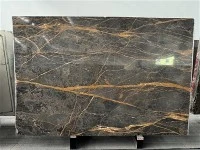
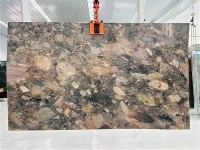


Polished Brazilian Cristallo Quartzite slab with a milky white field and fine honey-brown veining
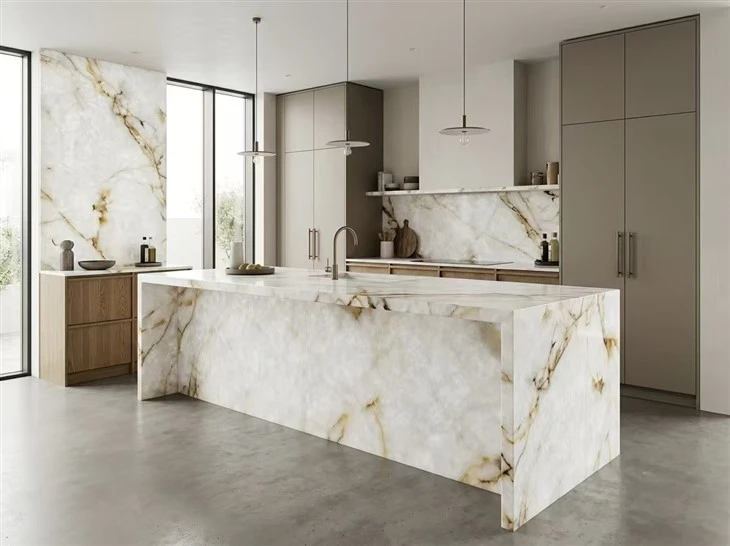
Cristallo Quartzite kitchen island, countertop and full-height backsplash with white crystals and gold-brown veining

LED-backlit Cristallo Quartzite bar counter with a luminous white crystalline surface and natural gold-brown veining

Cristallo Quartzite vanity top with an integrated stone sink installed on a floor-standing natural wood cabinet

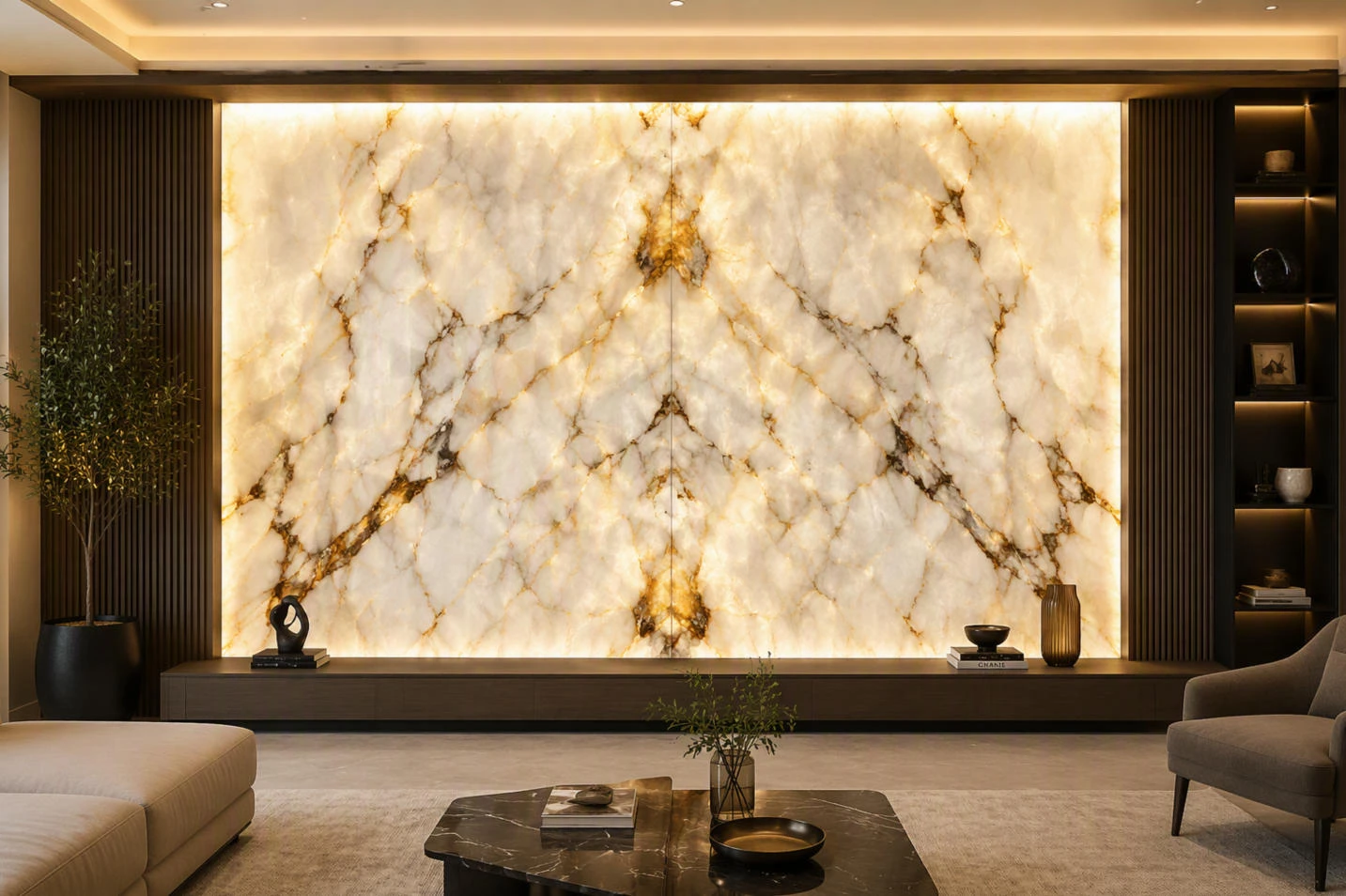
Book-matched Cristallo Quartzite feature wall with LED backlighting and symmetrical gold-brown veining

Built-in bathtub surround clad in Cristallo Quartzite with a white crystalline background and natural gold-brown veining
Cristallo Quartzite Brazil Slab
- Fast Delievery
- Quality Assurance
- 24/7 Customer Service
Executive Summary
Cristallo Quartzite is specified when a project needs the visual depth of a translucent, crystalline natural stone together with the scratch resistance associated with quartz-rich quartzite. The two submitted slab views show a bright white to milky-white body with semi-translucent crystal zones, soft ivory haze, linear and branching honey-gold veins, amber-brown concentrations, and limited dark brown to charcoal accents. Because every natural slab varies, these colors describe the photographed lot rather than a fixed production standard.
Geologically, quartzite is a non-foliated metamorphic rock formed when quartz-rich sandstone is transformed and recrystallized. Its interlocking quartz-grain structure contributes to durability, and quartz itself is the Mohs 7 reference mineral. Mohs hardness measures relative scratch resistance, not impact strength, flexural strength or immunity from fracture. Technical reference: U.S. National Park Service, Mohs Hardness Scale.

Key Facts

Commercial name: Cristallo Quartzite
Stone type: Natural quartzite
Origin: Brazil
Slab thickness: 18 mm and 20 mm
Recommended finishes: Polished or honed
Supply format: Slabs or cut-to-size
Availability: Current lot details upon request
Recommended uses: kitchen countertop and island, bathroom vanity tops, bar tops, feature walls and built-in bathtub surrounds.
Additional design opportunity: selected slab zones may be suitable for LED backlighting, subject to physical mock-up and approved lighting engineering.
Declared slab thickness tolerance: ±1 mm.
Product Introduction
Cristallo Quartzite combines a luminous crystalline appearance with assertive, naturally formed vein movement. In normal front lighting, the white and ivory field reads calm and mineral-rich, while the honey and brown lines provide direction for bookmatching, vein continuation or deliberately asymmetrical compositions. Under backlighting, the more translucent zones can reveal greater internal depth, but denser veins and mineral pockets may remain darker and create stronger contrast.
Quartzite should not be confused with engineered quartz. Quartzite is a natural metamorphic stone; engineered quartz is a manufactured composite using mineral aggregate and binders. Natural Stone Institute classifies quartzite among siliceous metamorphic stones and notes that natural stone varies in mineral composition, color and appearance. Source: Natural Stone Institute, Care & Cleaning of Natural Stone.
The material name alone does not establish every engineering property of a particular lot. Where a project requires verified absorption, abrasion resistance, flexural strength, anchoring performance or slip resistance, request project-relevant testing and consultant review. Test reports, if available, should be matched to the represented quarry, lot and test method rather than assumed from another quartzite.
Products Description
▌ Polished finish
A polished face generally increases reflectivity, emphasizes crystal depth and strengthens the visual separation between the pale background and amber or dark veining. It is often selected for feature walls, vanity tops, bar tops and backlit panels where the design intent calls for luminosity. Reflections, fingerprints and fine surface marks may be more visible under directional lighting.
▌ Honed or matte finish
A honed face softens reflection and gives the stone a quieter, more architectural character. Honey and brown movement may read less saturated than on a polished face. Finish samples should be approved because honing method, grit sequence and sealer can change apparent color and texture.
▌ Project processing options
• Slab supply in 18 mm or 20 mm, subject to current lot availability.
• Cut-to-size wall panels, vanity tops, bar tops, bathtub-surround components and custom stone elements.
• Waterjet or CNC cutouts, edge profiling, drilling, grooves, mitred build-ups and backing, depending on approved drawings and engineering.
• Bookmatch, vein match or controlled random layout using scanned images of the approved slabs.
• Factory dry layout for visual review and dimensional inspection where product format allows.
• For large sink or cooktop openings, a semi-cutout may be proposed so the opening remains temporarily connected during transport. The final release cut is completed by the installer at the jobsite, subject to approved fabrication and installation planning.
Recommended Applications
▌ Kitchen Countertops and Islands

Cristallo Quartzite is well suited to premium kitchen countertops and statement kitchen islands where the project requires natural visual character together with comparatively high scratch resistance. As a quartz-rich natural stone, true quartzite is generally harder and more resistant to everyday surface scratching than ordinary calcite-based marble. Its luminous white crystalline background, soft ivory clouding, honey-gold and amber-brown veins, and occasional dark mineral accents can create a distinctive appearance across perimeter countertops, full-height backsplashes and large island surfaces.
▌ Bar tops and hospitality counters
The crystalline background and gold-brown tracing can support refined residential bars, hotel lounges and reception counters. Designers can use front lighting for a quieter stone expression or controlled backlighting to turn selected areas into a focal feature. Bar-top design must account for support spacing, customer-side overhangs, equipment cutouts, seams, edge build-ups and potential contact with citrus, wine or cleaning chemicals. Coasters, prompt spill removal and neutral-pH cleaning remain sensible operational practices.

▌ Bathroom vanity tops

Cristallo Quartzite can bring a light, layered appearance to a floating vanity, double-basin top or integrated bathroom composition. For successful fabrication, the shop drawings should identify basin type, faucet holes, edge profile, backsplash, side splashes, cabinet support, overhang and all service clearances. Sink openings and narrow rails create weak sections, so handling support and temporary reinforcement should be planned before cutting. In wet use, coordinate joint design, sealing decisions and cleaning instructions with the installer and stone-care professional.
▌ Feature walls
Large-format panels can preserve the scale of the slab movement and reduce visual interruption. Before cutting, panel joints can be positioned through lower-activity areas, or intentionally aligned with major veins. The anchoring or adhesive system, substrate flatness, panel dimensions, service access and local code requirements must be reviewed by qualified project professionals. For bookmatched or continuous-vein schemes, scanned slab layout is particularly valuable because an approved digital composition can guide cutting and dry lay.
▌ Built-in bathtub surrounds

Cristallo Quartzite can be used for deck pieces, vertical aprons, returns and adjacent wall panels around a built-in bathtub. Accurate templates and coordinated shop drawings are important because tubs, waterproofing, access panels, faucets and substrates create multiple interfaces. Fabricators should avoid unsupported narrow strips and sharp internal corners where possible, while installers should follow the waterproofing and movement-joint design specified for the project. A polished finish provides more visual depth; a honed finish offers lower reflectivity.
Why Choose Cristallo Quartzite
• Natural visual depth: the crystalline body and irregular mineral movement create variation that printed or repeated patterns do not reproduce exactly.
• High scratch resistance relative to calcite-rich marble: quartz is Mohs 7 while calcite is Mohs 3. This is a mineral comparison, not a warranty that a finished surface cannot scratch or chip. Technical reference: U.S. National Park Service, Mohs scale.
• Backlighting potential: translucent zones can add a second visual identity after dark, especially in walls, bars and vanity features.
• Multiple design expressions: polished faces strengthen depth and reflectivity, while honed faces provide a softer reading.
• Project flexibility: available as slabs or coordinated cut-to-size products, depending on project requirements.
Comparison with Similar Stones
| Material | Visual character | General composition / behavior | Procurement implication |
| Cristallo Quartzite | Milky crystalline field with gold, amber, brown and occasional dark movement; variable translucency. | Natural quartzite; typically quartz-rich and comparatively scratch resistant. Natural fissures and weak sections still require careful fabrication and handling. | Approve actual slabs and conduct a backlight mock-up where applicable. |
| White marble | Often softer, more classical veining and a calcitic visual character. | Commonly calcite-rich. | Good where marble's patina and etching behavior are accepted; confirm maintenance expectations. |
| Onyx | Often strongly translucent with dramatic bands or clouds. | Calcareous and generally softer, requiring careful handling and maintenance. | Often chosen primarily for illuminated decoration rather than high-use horizontal surfaces. |
| Engineered quartz | More controlled color and pattern repetition; depends on manufacturer. | Manufactured composite, not natural quartzite. Resin content influences heat and UV behavior. | Useful when consistency is prioritized; verify the manufacturer's technical and warranty documents. |
| Light granite | Typically granular or crystalline, sometimes with movement but usually less translucent. | Natural igneous stone with project-specific performance. | May offer a more uniform functional appearance; verify selected lot and testing. |
How to Select This Stone
1. Define application and visual intent. State whether the stone will be a normal-lit vanity, a working bar top, a large feature wall or a backlit assembly.
2. Review current inventory. Request face-on slab photos, videos, dimensions, thickness and slab numbers. Ask for both front-lit and backlit observations if illumination matters.
3. Mark acceptance priorities. Identify acceptable and unacceptable dark regions, fissures, resin areas, open veins, edge conditions and color shifts.
4. Reserve enough matching material. Include cutting loss, vein alignment, defect avoidance, test pieces, site damage risk and future attic stock in the quantity plan.
5. Approve the finish on the actual material. A small polished or honed sample is useful, but a sample cannot represent all slab variation.
6. Develop shop drawings. Coordinate openings, seams, supports, edges, anchors, movement joints, backing and installation interfaces.
7. Simulate slab layout. Use approved slab scans in AutoCAD to locate each cut component and visualize vein continuation before production.
8. Mock up lighting. For backlit work, test actual stone thickness with the intended LED, diffuser, cavity depth and controls. Check the stone both day and night.
9. Approve dry layout and packing plan. Inspect finished pieces and define crate sequence, piece identification and jobsite unloading requirements.
Price Factors
Cristallo Quartzite pricing is project-based. Landiview Stone does not publish a fixed price because actual cost depends on the selected lot and required scope.
• Current block or slab availability, slab grade, color balance and translucency.
• 18 mm or 20 mm thickness, slab dimensions and usable yield.
• Number of slabs, required matching sequence and reservation period.
• Polished or honed finish, plus any special surface treatment.
• Cut-to-size complexity, CNC work, waterjet work, mitres, edges, holes, grooves, backing and reinforcement.
• Layout yield, bookmatching, vein continuity and defect avoidance.
• Shop drawings, scanning, AutoCAD layout planning, dry lay and inspection scope.
• Custom foam, plywood, timber crate design and temporary reinforcement.
• Destination port, container plan, Incoterm and shipment timing.
For a comparable quotation, send a bill of quantities, drawings, target thickness, finish, allowable variation, destination port and desired delivery schedule. Prices and lead times are available upon request.
Quality Control, Packing and Export Service
▌Slab inspection
• Check for cracks that may create a slab-breakage risk.
• Review overall vein harmony and identify visually disruptive large black patches.
• Record current slab photos, videos, measurements and slab numbers for buyer approval.
• Confirm finish, visible repairs and other lot-specific characteristics before shipment.
▌Cut-to-size workflow
1. Receive the client's architectural drawings and identify the stone scope.
2. Prepare detailed stone shop drawings for client review.
3. Submit current slabs for approval or, if the existing slabs are unsuitable, discuss block selection and new slab cutting.
4. After slab and shop-drawing approval, place component outlines on scans of the selected slabs in AutoCAD and submit the simulated cutting and assembly layout if necessary.
5. Cut and fabricate only after layout approval.
6. Dry lay finished pieces where applicable, inspect dimensions and appearance, and remake pieces that do not meet the agreed quality criteria.
7. Label, protect and pack pieces according to installation and delivery sequence.
This scan-to-layout method is designed to make the visible arrangement more predictable before cutting. It does not eliminate natural variation, lighting differences, site tolerances or installer responsibility.
▌Export protection
Slabs are packed in strong wooden crates and braced inside the container. Finished products receive cushioning, separators, edge protection and fixation based on geometry. Custom foam boxes and plywood may be used for integrated-sink counters, stone furniture and other fragile products. For vulnerable pieces such as long backsplashes, narrow strips, vanity tops and components with sink or cooktop openings, a protective film can be applied first, followed by temporary engineered-stone or similar reinforcement strips over the film. Installers remove the temporary strips before final installation.
Where large sink or cooktop openings would leave narrow rails, Landiview Stone may recommend a semi-cutout to retain temporary material across the opening during transport. Final jobsite cutting must follow the approved method and be completed by qualified personnel. These shop-drawing, scan-layout, temporary-reinforcement, custom-packing and semi-cutout practices are documented in Landiview Stone's internal process reference.
Frequently Asked Questions
Q: Can Landiview Stone provide Cristallo Quartzite samples?
A: Yes. We can normally provide one or two samples free of charge. Typical sample sizes range from 100 × 100 mm to 200 × 200 mm. The courier cost should be paid by the customer. A sample helps confirm surface finish and general material character, but it will not represent the full color, veining or translucency variation of an entire slab.
Q: What is the thickness tolerance for your slabs?
A: Our stated slab thickness tolerance is ±1 mm. If the order requires calibrated finished pieces, tight interface tolerances or a special substrate system, the required finished-product tolerance should be written into the approved drawings and purchase documents before production.
Q: How do you control slab-face quality?
A: During slab acceptance, we focus on whether there are cracks that could lead to slab breakage, whether the overall vein movement is harmonious, and whether there are visually disruptive large black patches. We document the actual slabs for client review. Because Cristallo is natural stone, agreed acceptance criteria should distinguish natural mineral features from unacceptable structural or visual conditions.
Q: Can I see current slab photos before ordering?
A: Yes. Current slab photos, videos and measurements are available before order. For a traceable approval, we recommend that buyers record the approved slab numbers, dimensions, thickness, finish and face images in the purchase documents. Backlit observations can also be discussed for relevant lots.
Q: Can you supply finished cut-to-size products instead of slabs?
A: Yes. Landiview Stone supplies both slabs and cut-to-size products for commercial and residential projects. Our typical project workflow is: Send us the designer's architectural drawings. Our technical team extracts the stone scope and prepares detailed stone shop drawings for approval. Review current slab images. If the existing slabs do not meet the project's visual target, block selection and new slab cutting can be discussed. After the slabs and stone shop drawings are approved, we place the cut components on scans of the selected slabs in AutoCAD. We submit the simulated cutting and assembly effect for review before cutting. After client approval, the factory fabricates the pieces according to the approved drawings and layout. We conduct a factory dry lay where practical, inspect the finished work and reproduce pieces that do not meet the agreed quality requirements. We pack the finished products with project-specific internal cushioning, edge protection and reinforcement for transport. For a more detailed purchasing workflow, read How to Order Cut-to-Size Stone from China: A Practical Buyer Guide.
Q: Can you prepare stone shop drawings from the designer's architectural drawings?
A: Yes. Clients can send the full architectural drawing package prepared by their designer. Landiview Stone's technical team can identify the stone-related elements and prepare dedicated, detailed stone shop drawings for client review. Shop drawings should be coordinated with the architect, structural requirements, MEP interfaces, cabinetry, waterproofing and site dimensions before production.
Q: If I order finished products, how do you help ensure the installed result matches the approved design?
A: After the selected slabs and stone shop drawings are approved, we use scans of those slabs to simulate cutting and assembly in AutoCAD. The buyer reviews the proposed vein composition and part positions before cutting. Approved layouts guide fabrication, and a factory dry lay is used where practical to confirm the relationship among pieces. This provides a stronger visual-control process than cutting from a generic material reference, although final appearance also depends on site lighting, installation tolerances and workmanship.
Q: How do you protect slabs and finished products during transport?
A: For slabs, we use strong wooden crates and add timber bracing inside the container. For finished products, we design the internal protection around the actual shape, size and cutout locations. Custom foam boxes may be used for integrated-sink counters, stone furniture or other vulnerable assemblies. Before export packing, fragile pieces may receive temporary reinforcement to reduce breakage risk during factory handling, crate loading, sea freight, unloading and jobsite movement. After applying protective film to the finished face, we can attach temporary engineered-stone strips or similar support materials over the film. These strips support weak areas around openings, narrow edges, long profiles and corners. They are removed by the installer before installation and, because they sit over protective film, normally avoid direct adhesive contact with the finished stone.
Q: How should installed Cristallo Quartzite be maintained?
A: Blot spills promptly rather than spreading them. Clean with a neutral cleaner, stone soap or a small amount of mild dishwashing detergent in warm water. Rinse and dry with a soft cloth. Use coasters and trivets, and avoid abrasive pads. Natural Stone Institute notes that quartzite is a siliceous stone and is generally resistant to many kitchen acids, but still advises against acidic cleaners because trace minerals may be acid sensitive. Sealer requirements depend on actual stone porosity, finish and use, so ask the fabricator or stone-care professional to test the selected material and recommend an impregnating sealer if needed. Source: Natural Stone Institute, Care & Cleaning of Natural Stone.
Q: Is Cristallo Quartzite suitable for LED backlighting?
A: Many Cristallo slabs contain translucent crystalline zones, including the submitted lot. However, light transmission can vary significantly within one slab. We recommend a physical mock-up using the actual slab or offcut, the proposed LED module, diffuser, cavity depth and control system. The mock-up should check hotspots, shadow lines, dark veining, heat management, access and appearance under both ambient daylight and night conditions.
Q: What visual difference should I expect from 3000K, 4000K and color-adjustable LED lighting?
A: As a practical design expectation, 3000K warm-white light tends to enrich cream, honey, gold and amber areas. A 4000K neutral-white system generally makes the white crystal body read cleaner and can increase the perceived definition of dark mineral lines. Tunable-white systems let the project shift between warmer hospitality scenes and cleaner display scenes. RGB or RGBW lighting can create colored effects, but saturated colors may obscure the stone's natural white-and-gold identity. CCT describes color appearance in kelvin, but it does not by itself define brightness, color rendering, spectral quality or uniformity. Specify CRI, LED binning, diffuser, dimming and mock-up acceptance separately. Technical reference: CIE International Lighting Vocabulary.
Q: Is Cristallo Quartzite harder than ordinary marble?
A: True quartzite is predominantly quartz-rich, while many marbles are calcite-rich. Quartz is Mohs 7 and calcite is Mohs 3, so quartzite normally has significantly higher scratch resistance than calcitic marble. Mohs is an ordinal scratch-resistance scale, not a measure of impact strength or fracture resistance. Technical reference: U.S. National Park Service, Mohs Hardness Scale.
Why Landiview Stone
Landiview Stone is a project-oriented natural stone supplier supporting buyers from slab selection to cut-to-size fabrication, shop-drawing coordination, dry-layout inspection and export packing. For premium materials such as Cristallo Quartzite, the goal is to help clients control not only stone quality but also the intended installation effect.
Our team has supported a range of high-end international stone projects, including marble furniture, bathroom vanity tops and shower-wall panels for the Grand Hyatt Singapore renovation project; stone supply for Singapore's Thomson-East Coast Line stations; interior stone products for the Wynn project in the United Arab Emirates; marble products for the public areas of the 255 East 77th Street luxury residential project in New York; and interior and exterior marble and granite products for three high-end custom homes on Tuckahoe, a private resort island in Massachusetts, USA.
Based on this project experience, Landiview Stone understands the importance of current-slab confirmation, color and vein control, shop-drawing review, slab-layout simulation, careful fabrication and reinforced export packing. We work with importers, contractors, developers, designers and builders requiring reliable stone supply for luxury residential, hospitality, public and custom architectural work.
• Current slab photos, videos and measurements available before order.
• Support for slabs, vanity tops, wall panels, stone furniture and cut-to-size products.
• Shop-drawing review and scanned-slab layout planning for project orders.
• Dry-layout inspection and reinforced export packing for finished products.
• Experience across hospitality, public infrastructure, luxury residential and custom-home projects.
Project references describe Landiview Stone's stated supply experience and do not imply endorsement by the named owners, operators or projects. Additional reference details are available upon request, subject to confidentiality.
Request Current Slabs and a Project Quote
Landiview Stone works with architects, interior designers, contractors, fabricators, and developers to supply slabs and manufacture custom stone components according to project drawings. We can assist with shop drawings, slab selection, vein direction, bookmatching, cut-to-size production, countertop and vanity fabrication, edge profiles, sink cutouts, surface finishing, dry fitting, and protective export packaging.
Hot Tags: Cristallo Quartzite slab, Brazilian quartzite slab, translucent quartzite, backlit quartzite, natural quartzite supplier, Cristallo stone, quartzite vanity top, quartzite bar top, quartzite wall panels, cut-to-size quartzite, Landiview Stone
You Might Also Like
Send Inquiry