


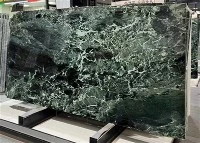


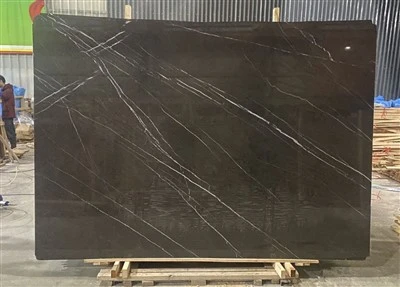
Polished Chinese Grand Antique Marble slab with a dramatic black background and bold fragmented white veining displayed in Landiview Stone factory

Chinese Grand Antique Marble kitchen countertop, full-height backsplash and waterfall island with mitered edges in a contemporary luxury kitchen

Chinese Grand Antique Marble double vanity with integrated sinks, matching backsplash and mitered front edges in a luxury bathroom

Chinese Grand Antique Marble floor tiles with visible joints and dramatic white veining installed in a luxury hotel lobby

Chinese Grand Antique Marble wall tiles with visible panel joints and dramatic white veining installed in a luxury hallway

Chinese Grand Antique Marble interior staircase with illuminated treads, metal stringers and glass railings in a luxury residence

Chinese Grand Antique Marble bathtub deck and surround with mitered corners and concealed base lighting in a luxury bathroom

Chinese Grand Antique Marble fireplace surround with book-matched veining and mitered edges in a contemporary luxury interior
Chinese Grand Antique Marble Slab
- Fast Delievery
- Quality Assurance
- 24/7 Customer Service
Executive Summary
Choose Chinese Grand Antique Marble when the design requires a dramatic black-and-white natural composition similar in visual direction to French Grand Antique d'Aubert, but with a generally more cost-effective sourcing option. The two materials have different origins, so buyers should compare actual slabs, usable yield, thickness, finish, fabrication scope and logistics rather than relying on the shared commercial name.
Chinese Grand Antique Marble is a natural marble from China developed for slab importers, distributors, fabricators, stone contractors, interior designers, developers and builders. It features a dramatic black background, bold fragmented white veining and a strong gloss after polishing. Its visual character is similar to French Grand Antique d'Aubert, but it is a separate Chinese-origin material and generally provides a more cost-effective sourcing option, depending on the selected slabs, specifications, fabrication requirements and logistics. Standard slabs are 18 mm thick, while suitable blocks may be selected and custom cut to 20 mm or 30 mm when project requirements and current material permit. Landiview Stone supplies both slabs and project-specific cut-to-size or finished stone products.

Key Facts
This is a Chinese natural marble offered primarily in 18 mm slabs, with polished or honed finishes. Custom 20 mm and 30 mm slab cutting may be studied through block selection, subject to block suitability, required size, quantity and current availability.
| Product Attribute | Confirmed Information |
| Product name | Chinese Grand Antique Marble |
| Material | Natural marble |
| Origin | China |
| Color and visual character | Dramatic black background with bold fragmented white veining |
| Standard slab thickness | 18 mm |
| Alternative thicknesses | 20 mm and 30 mm may be custom cut from selected blocks according to customer requirements, subject to suitable block and production availability |
| Stated thickness tolerance | ±1 mm; confirm measurement method and project acceptance criteria before ordering |
| Recommended finishes | Polished and honed |
| Supply forms | Slabs and project-specific cut-to-size or finished stone products |
| Natural variation | Each slab varies; approve actual slabs, usable areas, surface observations and matching expectations |
Available Finishes and Processing Options
Polished is the recommended choice when maximum black-and-white contrast and reflected depth are desired. Honed gives a quieter, lower-sheen reading. Finish samples and current slabs should be reviewed together because finish changes the perceived depth, color and visibility of natural features.
▌ Polished Finish
Polishing deepens the black field, sharpens the white fragments and produces the strong gloss associated with this Chinese marble. It works particularly well on statement islands, vanity fronts, feature walls and fireplace compositions. Reflections can also reveal surface variation, so buyers should assess current slabs and the approved finish under representative lighting.
▌ Honed Finish
A honed surface reduces glare and gives the same graphic pattern a more restrained architectural character. It can suit floors, walls, stairs and interiors where a softer visual effect is preferred. Slip resistance, wear, maintenance and finish level must be assessed for the specific installation rather than inferred from the finish name alone.
▌ Processing and Approval
Available processing may include cutting, edge work, miter joints, cutouts, slab scanning, AutoCAD cutting and vein-layout simulation, dry layout, inspection and piece numbering, depending on the approved scope. For large sink or cooktop openings, a semi-cutout may be considered when material and site conditions permit; retained connections and site completion responsibility must be shown in approved drawings. Natural fissures, structural cracks and fabrication damage should be evaluated separately.
Recommended Applications
The stone is most effective where broad, continuous surfaces allow its white fragments to read as an intentional composition. Select slabs by the finished elevation, not by color alone, and coordinate seams, edges and adjacent pieces before cutting.
▌ Kitchen Island and Kitchen Countertop

A large island turns the black field and fractured white pattern into a sculptural centerpiece. Waterfall ends, mitered edges and a full-height backsplash can extend the composition, but vein direction and seam positions should be planned from approved slab scans. Marble can etch from acids; support, cutout geometry, sealing and care expectations must be coordinated with qualified fabricators and installers.
▌ Bathroom Vanity Top
On a vanity, the high contrast frames basins and fittings while giving a compact surface greater visual depth. A matching backsplash or mitered apron can create a unified furniture-like form. Sink cutouts, faucet clearance, edge distances and cabinet support should be checked against the actual templates and approved shop drawings.

▌ Floor Tiles

Floor tiles create a rhythmic black-and-white field with visible joints moderating the fragmented veining. Large-format modules can feel more continuous, while smaller modules create a more graphic cadence. Buyers should approve the tile grouping, finish, joint strategy and movement of adjacent pieces; the project professional must verify slip, substrate, traffic and installation requirements.
▌ Wall Tiles
Wall tiles use the bright white fragments as an architectural graphic against the black background. Planned panel joints can organize the movement, and selected adjoining pieces can strengthen continuity across a lobby, bathroom or corridor. Elevation drawings, piece numbering and dry-layout records help transfer the approved arrangement to the site.

▌ Interior Staircases

On interior staircases, repeated black treads with strong white movement create a dramatic ascending sequence. Vein distribution should be balanced from step to step so one isolated piece does not dominate unintentionally. Tread support, nosing detail, finish, slip considerations and local code requirements must be resolved by the project team and qualified installer.
▌ Bathtub Deck and Surround
A bathtub deck and surround can read as a single carved volume when mitered corners and adjoining veins are coordinated. The black surface creates visual depth around the tub while the white fragments define edges and planes. Wet-area detailing, waterproofing, movement joints, support, sealant compatibility and maintenance must follow project specifications and manufacturer guidance.

▌ Fireplace

A fireplace surround concentrates the marble's contrast into a strong focal frame. Book-matched or deliberately paired panels can produce symmetry, while mitered returns preserve the visual mass of the stone. The stone layout must be coordinated with heat clearances, substrate, attachment design, local regulations and the fireplace manufacturer's requirements.
Why Choose This Stone
Chinese Grand Antique Marble offers the visual impact of a black-and-white brecciated composition with a strong polished gloss and a generally more cost-conscious sourcing position than the similarly named French material. The two products should not be represented as the same origin or quarry.
▌ High-Contrast Natural Composition
The defining value is the relationship between the deep black ground and irregular white fragments. Unlike a uniform manufactured pattern, each slab creates a different composition. This makes slab selection and layout central to the design result rather than a secondary production step.
▌ Strong Polished Appearance
After polishing, the material can achieve a very good gloss that intensifies the black field and crisp visual contrast. Buyers should approve the actual finish because lighting, resin treatment, surface flatness and natural features can affect the final reading.
▌ Chinese Alternative with Distinct Origin
A French stone is also sold as Grand Antique, commonly identified as Grand Antique d'Aubert and quarried in France. Authoritative commercial descriptions identify it as a French black brecciated marble [5]. Chinese Grand Antique Marble is a separate Chinese-origin product with a very similar black-and-white visual direction and can offer better value depending on slab selection, specification and logistics. Quotations should compare actual slabs, usable yield, thickness, finish and service scope, not the shared commercial name alone.
Comparison with Similar Stones
Compare these stones through actual slabs and project criteria. A shared black-and-white palette does not establish identical origin, geology, performance, resin treatment, availability or price.
| Stone | Typical Visual Direction | Material and Origin | Typical Uses | Buyer Considerations |
| Chinese Grand Antique Marble | Dramatic black background with bold fragmented white veining | Natural marble from China | Islands, countertops, vanities, floors, walls, stairs, bathtub surrounds and fireplaces | Approve current slabs, usable yield, natural features, finish, thickness and vein-layout plan; generally positioned as a better-value option than the visually similar French material |
| Grand Antique d'Aubert | Strong black-and-white brecciated contrast | Natural marble from France [5] | Interior floors, walls, stairs, furniture and luxury features | Separate French origin and supply chain; do not treat the shared name as proof of equivalence; compare actual availability, documentation and total scope |
| Nero Marquina | Black field with generally finer or more linear white veining | Commercial black marble; confirm source and classification for the offered lot | Countertops, vanities, floors, walls and fireplaces | Usually reads less fragmented; approve the actual veining scale, fissures, finish and resin treatment |
| Black-and-white engineered surface | Designed pattern with greater repeatability, depending on product | Manufactured material, not natural marble | Interior surfaces allowed by the manufacturer | More controlled pattern but a different material identity; verify heat, UV, fabrication, warranty and application limits with the manufacturer |
Frequently Asked Questions
For accurate procurement, define the actual slab or block, nominal thickness, tolerance method, finish, visual approval range, fabrication scope, packing and destination requirements in the order documents.
Q: Can you provide Chinese Grand Antique Marble samples?
A: Yes. Normally one or two samples can be provided without a sample charge, with typical sizes from 100 × 100 mm to 200 × 200 mm. Courier cost is paid by the customer, and availability depends on the current material. A small sample is useful for reviewing finish, basic color contrast and surface character, but it cannot represent the full scale or distribution of the fragmented white veining. Buyers should therefore approve current slab photos or videos as well as the sample before ordering.
Q: What is your slab thickness tolerance?
A: The stated slab thickness tolerance is ±1 mm. Before ordering, the buyer should define the nominal thickness, measurement method, sampling plan and acceptance criteria in the contract, approved drawings or inspection standard. Local variation, surface finish and any resin or mesh treatment should also be considered when dimensions are checked. For fabricated work, the approved shop drawings and adjoining components should govern the finished dimensional requirements.
Q: Can I order 20 mm or 30 mm Chinese Grand Antique Marble slabs?
A: Yes, 20 mm and 30 mm slabs can be considered through block selection and project-specific slab cutting. Availability is not assumed and depends on a suitable current block, required slab size, quantity, visual range and production feasibility. Standard slabs are commonly supplied at 18 mm. Buyers requiring thicker slabs should state the minimum usable dimensions, finish, quantity, tolerance and whether book-matched or sequential slabs are needed.
Q: How do you inspect Chinese Grand Antique Marble slab surfaces?
A: Inspection focuses on cracks that may affect handling or fabrication, overall visual coordination, unusually large and discordant dark areas, and color or vein variation against the buyer-approved range. Natural veining, mineral variation and natural fissures must be distinguished carefully from structural cracks and processing defects. Current slab identification, surface observations and buyer acceptance criteria should be documented before shipment; project-specific testing can be discussed when the specification requires it.
Q: Can I see current slab photos and videos before ordering?
A: Yes. Subject to actual stock, Landiview Stone can provide current-lot photos, videos, slab numbers, surface-review information and an overview of the available color and vein range. Because lighting, camera settings and displays can alter appearance, digital media should support rather than replace clearly defined approval criteria. Requested slabs should remain identified through confirmation, inspection and packing, subject to final availability.
Q: Can you supply cut-to-size and finished products, not only slabs?
A: Yes. The usual workflow is: the client submits architectural drawings; the technical team prepares stone shop drawings for review; available slabs are submitted, or block selection and special slab cutting may be investigated if appropriate. After drawings and slabs are approved, slab scans are used in AutoCAD for cutting and vein-layout simulation. Following approval, pieces are fabricated, dry laid, inspected, replaced where required, numbered and protected for export. See how to order cut-to-size stone from China.
Q: Can Landiview Stone prepare stone shop drawings from architectural drawings?
A: Yes. Landiview Stone can review architectural drawings, identify the stone scope and prepare stone shop drawings showing relevant dimensions, thicknesses, joints, cutouts, edge details, visible surfaces, finishes and agreed reinforcement information. The client and design team must review and approve the drawings before fabrication. Stone shop drawings do not replace the structural, code-compliance or installation responsibility of locally licensed professionals. See what cut-to-size stone means for a project order.
Q: How do you help control the final vein layout and installed appearance?
A: Approved slab scans can be imported into AutoCAD so that piece positions, vein direction and relationships between adjoining parts are reviewed before cutting. The approved layout then guides fabrication; factory dry layout checks the actual finished pieces, supports replacement decisions and enables piece numbering for installation. This process reduces information gaps but does not guarantee an identical site appearance because natural variation, lighting, joints and site installation affect the result. See natural stone slab layout in AutoCAD.
Q: How do you protect slabs and finished stone during shipping?
A: Slabs are packed in sturdy export crates or A-frame and support systems designed for the actual container plan. Finished products may use linings, cushioning, custom foam, separators, edge protection and positioning supports. Vulnerable sink or cooktop cutouts, narrow backsplashes, strips, vanity tops, fireplace parts, narrow wall panels and fragile corners may receive removable support strips over protective film. These are transport measures and should be removed before installation as instructed. Regulated wood packaging must use material compliant with destination requirements, including ISPM 15 where applicable [3]. See stone shipping protection guidance.
Q: How should installed Chinese Grand Antique Marble be maintained?
A: Use a pH-neutral cleaner intended for natural stone, blot spills promptly, rinse as directed and use soft cloths or non-abrasive tools. Avoid unidentified acidic or strongly alkaline cleaners, abrasive pads and products not approved for marble, because calcareous stone is acid-sensitive [1]. Sealer selection and reapplication intervals depend on the selected stone, finish, exposure, installation and sealer manufacturer's instructions. Follow the project specification and obtain advice from the installer or stone-care product manufacturer for the actual environment.
Q: Is Chinese Grand Antique Marble suitable for kitchen countertops?
A: It can be specified for kitchen countertops and islands when the buyer accepts marble's care profile and the project uses suitable fabrication, support, sealing and installation details. The black field and fragmented white veining create a strong monolithic or graphic composition, especially across a waterfall edge or full-height backsplash. Because marble is acid-sensitive and can etch, the owner should understand maintenance expectations. Large cutouts, edge distances, supports and site completion of any semi-cutout must be coordinated in approved drawings.
Q: How is Chinese Grand Antique Marble priced?
A: Pricing is project-specific rather than determined by the stone name alone. Relevant factors include current slab or block availability, usable slab size and yield, visual selection, thickness, finish, resin or mesh treatment, quantity, cutting complexity, mitered edges, cutouts, shop drawings, slab scanning, dry layout, inspection, packing and destination logistics. For a meaningful comparison, request quotations against the same drawings, dimensions, quality criteria, packing scope and Incoterm rather than comparing only a headline square-metre price.
Why Landiview Stone
Landiview Stone supports both slab procurement and drawing-led custom fabrication. The practical advantage is coordination from material approval through shop drawings, digital layout, inspection, piece identification and export protection, with the scope defined for each order.
Landiview Stone supplies natural stone in two principal forms: slabs for importers, distributors and fabricators, and project-specific cut-to-size or finished stone products for contractors, developers, designers, builders and other project buyers.
For slab buyers, available support includes current slab selection, slab-image review, color and vein-range confirmation, surface inspection, slab identification and export packing.
For custom work, the workflow may include:
- 1. Review architectural drawings and identify the stone scope.
- 2. Prepare stone shop drawings for client and design-team approval.
- 3. Submit available slabs; if unsuitable, investigate block selection and special slab cutting when appropriate.
- 4. Use approved slab scans in AutoCAD to simulate cutting and vein layout before production.
- 5. Fabricate to approved documents, then dry lay, inspect and number finished pieces.
- 6. Replace nonconforming pieces when required while considering adjacent color and veining.
- 7. Apply project-specific protection, including temporary reinforcement for vulnerable geometry, before export packing.
For complex assembled stone products, the team may use three-dimensional modeling and virtual assembly review to examine component relationships, material thicknesses, surface treatments, concealed reinforcement and potential interference before fabrication details are finalized.
▌ Selected International Project Experience
- • Marble furniture, bathroom vanity tops and shower wall panels for the Grand Hyatt Singapore renovation project
- • Stone supply for stations on Singapore's Thomson-East Coast Line
- • Interior stone products for the Wynn project in the United Arab Emirates
- • Marble products for public areas of the 255 East 77th Street luxury residential project in New York
- • Interior and exterior marble and granite products for three high-end custom homes on Tuckahoe, a private resort island in Massachusetts, USA
Request A Quote
For a comparable quotation, send the required supply form, finished dimensions, nominal thickness, quantity, finish, application, quality criteria and delivery destination. Include architectural drawings, stone schedules or templates when available.
Ask Landiview Stone about current Chinese Grand Antique Marble slab availability or a project-specific fabrication scope. Depending on actual material and order requirements, the response can include current slab photos or videos, slab identification, a quotation and proposed coordination for shop drawings, vein layout, dry-layout inspection, piece numbering and export packing.
For 20 mm or 30 mm slabs, state the minimum slab dimensions and quantity so suitable block selection and custom cutting can be evaluated. For countertops, vanities, stairs, surrounds or fireplaces, provide drawings and identify visible faces, joints, cutouts, edge details and matching expectations.
Hot Tags: Chinese Grand Antique Marble, black and white marble, Chinese marble slabs, Grand Antique marble supplier, cut-to-size marble, polished marble slabs, Landiview Stone, Black Marble Noir Aziza Slabs, Blue Roma Quartzite, Dedalus Marble Prada Green Natural Stone For Wall Flooring, Nior Grand Antique Marble Interior Design, Popular Nero Marquina Marble Slabs, Wooden Marble
Previous
No InformationYou Might Also Like



Send Inquiry