


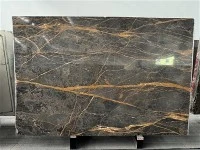
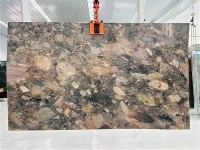
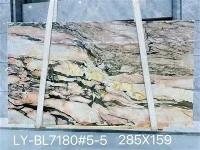


Allure Royale quartzite slab with a smoky gray background and fine silver-white crystalline veining

Allure Royale quartzite kitchen countertops and waterfall island in a modern luxury kitchen

Allure Royale quartzite bathroom vanity top with integrated rectangular sink

Allure Royale quartzite interior staircase with stone treads, risers and glass balustrade
Allure Royale Quartzite Slabs
- Fast Delievery
- Quality Assurance
- 24/7 Customer Service
Executive Summary
Allure Royale quartzite is selected for projects that need a dark grey natural-stone field with expressive golden-white movement. It is relevant to slab importers and fabricators as well as contractors, designers, developers and builders sourcing finished stone. The appropriate buying route is to review actual available slabs, confirm thickness and finish, then define whether the order is for slabs or coordinated custom fabrication.
Originating from Brazil, Allure Royale is supplied as natural quartzite. Its directional stripes and veins make slab selection and cut orientation important, particularly where islands, backsplashes, vanity components or stair pieces must read as one composition. Landiview Stone offers 20 mm as the standard slab thickness. A 30 mm slab program may be studied through block selection and special cutting when the required block, quantity and project conditions allow. Polished and honed finishes are recommended. Buyers should approve identified current slabs rather than rely only on a product name or a representative image.

Key Facts
The confirmed specification is Brazilian natural quartzite in a dark grey range with golden-white stripes and veins, normally supplied at 20 mm thickness with polished or honed finish options. Exact slab dimensions, lot appearance, surface treatment, available quantity and 30 mm block-cutting feasibility are order-specific and should be documented before purchase.
| Product Attribute | Buyer Information |
| Commercial name | Allure Royale quartzite slab |
| Material | Natural quartzite. |
| Declared origin | Brazil |
| Color and movement | Dark grey field with golden-white stripes and veins. Natural range, vein density, transitions, fissures, inclusions and treatment may differ by slab and lot. |
| Standard slab thickness | 20 mm |
| Optional thickness | 30 mm slabs may be specially cut from selected blocks, subject to suitable block availability, quantity, yield and project requirements. |
| Declared thickness tolerance | ±1 mm. Measurement method, locations and acceptance criteria should be defined in the contract, approved drawings or inspection standard before ordering. |
| Recommended finishes | Polished and honed |
| Recommended applications | Kitchen islands, kitchen countertops, bathroom vanity tops and interior staircases, subject to detailed design, support, fabrication, installation and local project requirements. |
| Supply formats | Slabs for importers, distributors and fabricators; cut-to-size or finished products for project buyers. |
| Approval inputs | Current slab images or videos, slab numbers, dimensions, thickness, finish, approved color and vein range, and treatment information where relevant. |
Available Finishes and Processing Options
Choose polished finish to emphasize depth, contrast and reflective definition in the grey and golden-white movement. Choose honed finish for a lower-sheen, more subdued reading. A finish sample and images of the actual finished slab are preferable where appearance is critical, because finish, lighting, sealer and the selected slab can all change the perceived color.
- • Polished: Recommended when the design calls for stronger tonal depth and crisp vein contrast. Review reflections, edge polish, resin-filled areas and maintenance expectations under representative lighting.
- • Honed: Recommended for a softer, low-sheen appearance. Confirm the target sheen, uniformity, fingerprint visibility and sealer compatibility on representative material before full production.
- • 20 mm slab supply: The standard route for buyers who will fabricate in the destination market. Actual dimensions and usable boundaries depend on current slabs.
- • Project-dependent 30 mm slabs: Suitable blocks can be investigated for special cutting. This is not a standing availability claim; block quality, yield, quantity and schedule must be evaluated.
- • Cut-to-size fabrication: Depending on approved drawings, production can include straight and shaped cutting, visible-edge finishing, mitres or build-ups, cutouts, holes, backsplashes, risers, treads and piece identification.
- • Vein-layout coordination: Scans of approved slabs can be used in AutoCAD to propose piece locations and vein relationships before release for cutting.
Fabrication scope must be coordinated with the actual material, finished thickness, support, seams, cutout geometry, handling method and installation sequence. A visually preferred slab area may not be practical for a narrow bridge, mitred edge or other vulnerable geometry. Final details should be documented in approved shop drawings, and structural or installation decisions remain subject to the project specification and qualified local professionals.
Recommended Applications
Allure Royale quartzite is recommended for kitchen islands and countertops, bathroom vanity tops and interior staircases where its directional grey-and-gold movement can be deliberately composed. Suitability is not determined by the stone name alone. Slab condition, testing where specified, thickness, support, cutout geometry, finish, installation and maintenance must be evaluated for the actual project.
▌ Kitchen Islands and Countertops

A large island can display broad vein movement with fewer visual interruptions, while perimeter counters may require deliberate seam and backsplash coordination. Buyers should define the focal view, vein direction, waterfall relationships, edge profile, appliance openings, sink position and seam locations before the slab is allocated. The cutting plan should reserve adequate material for edge build-ups, backsplashes and replacements rather than using nominal square area alone.
Large sink or cooktop openings create narrow stone bridges and handling risk. Depending on the selected slab, thickness, support and site capability, a semi-cutout may be considered so selected connections remain during transport and are completed on site. This method requires explicit shop-drawing notes, protected handling and qualified site completion. Supports, cabinets, overhangs and installation must follow the approved project design and applicable local requirements.
▌ Bathroom Vanity Tops
The dark grey field can anchor light cabinetry, metal finishes and warm interior palettes, while the golden-white lines can be positioned around basins or carried into backsplashes. Selection should account for faucet holes, basin template, backsplash thickness, front and rear stone widths, cabinet clearances and access for installation. For a typical project, Landiview Stone reviews the actual sink template and faucet specification rather than treating a generic cutout dimension as final.
Wet-area use calls for properly detailed joints, substrate support, compatible setting materials and planned sealing and cleaning. Natural quartzite is siliceous, but mineral composition and surface treatments can vary. Neutral cleaning and prompt spill care remain conservative practice. The installer and sealer manufacturer should verify product compatibility and application instructions. [2]

▌ Interior Staircases

Directional veins can help establish movement along a flight or create a controlled rhythm across treads and risers. The layout decision should define whether adjacent steps will blend, progress sequentially or use intentional variation. Shop drawings should coordinate tread and riser dimensions, nosing or edge profile, landing interfaces, finished faces, joints, supports and piece numbers.
Stair safety and performance depend on more than material hardness. Finish, slip resistance, edge geometry, substrate, anchorage, expected traffic and local codes require project-specific review. Mockups or representative samples may be appropriate when appearance or underfoot performance is critical. Stone should be selected and detailed as part of the complete assembly, consistent with industry guidance on application-based stone selection. [3]
Why Choose This Stone
Choose Allure Royale when the project needs genuine dark grey natural-stone variation combined with warm golden-white linear movement. Its strongest value is compositional rather than uniform: the result depends on selecting the right current slabs and deciding how veins, tonal transitions, seams, cutouts and adjoining pieces should work together.
- • Distinctive but versatile palette: Dark grey can provide visual weight, while white and warm-toned lines connect with metal, timber, painted cabinetry and neutral interiors.
- • Large-format visual potential: Islands, long vanities and stair sets can use directional movement as an intentional design element rather than treating every piece independently.
- • Two recommended sheen directions: Polished finish emphasizes contrast; honed finish moderates reflection and visual intensity.
- • Flexible supply path: Buyers can request slabs or coordinate project-specific cut-to-size and finished components.
- • Approval can follow the actual material: Current slab numbers, images or videos and the accepted visual range can be documented before production, subject to availability.
Natural variation is part of the material, not a defect by definition. Fissures, veins, mineral concentrations, filled areas and tonal changes must be evaluated in context. Inspection should distinguish stable natural features and accepted repair or treatment from open, unstable or structurally relevant cracking, fabrication damage and other conditions that may affect handling, processing or service. Where performance is critical, request current test documentation or arrange testing appropriate to the intended use. ASTM's public C616/C616M-22 abstract identifies absorption, density, compressive strength, modulus of rupture and abrasion resistance as property categories for quartz-based dimension stone, but this page does not assign any value to Allure Royale. [1]
Comparison with Similar Stones
Compare Allure Royale with other dark or warm-veined stones by actual slab appearance, verified material category, finish, treatment, performance documentation and usable yield. A commercial name is not enough: two materials with similar colors may differ in mineral composition, acid response, fabrication behavior, maintenance and lot-to-lot availability.
| Stone | Typical Visual Direction | Material Category | Typical Uses | Buyer Considerations |
| Allure Royale | Dark grey field with golden-white stripes and veins; approve the actual slabs for movement and range | Natural quartzite | Kitchen islands, countertops, vanity tops and interior staircases | Confirm current slabs, thickness, finish, treatment, usable yield, fissures, layout and application-specific documentation. |
| Belvedere | Typically sold with a black to charcoal field and sweeping white, cream or gold movement; individual lots vary | Often commercially sold as quartzite; verify the selected lot and supporting documentation | Islands, countertops, walls and statement surfaces | Usually stronger black-and-white contrast than a grey-led palette. Compare actual slabs, finish, filled areas, usable yield and fabrication plan. |
| Infinity Black or similar black quartzites | Dark field with linear or cloudy pale veins; trade names and appearances vary by supplier | Verify whether the offered lot is geological quartzite and review current documentation | Countertops, vanities, stairs and feature panels | Do not assume equal acid response, strength or maintenance from appearance. Require current-slab approval and application-relevant information. |
| Soapstone | Soft charcoal to green-grey field, often with lighter veins and a quieter surface character | Natural soapstone | Countertops, hearths and interior work surfaces | Different tactile and wear behavior; generally develops marks and patina more readily. Compare maintenance expectations rather than treating it as a quartzite substitute. |
| Dark grey marble with warm veining | Grey field with white, cream or gold veins, sometimes visually comparable from a distance | Calcareous natural stone | Vanities, walls, furniture and selected counters | Calcareous stones are acid-sensitive and can etch. Maintenance expectations differ from siliceous stone; confirm use, finish and care plan. [2] |
The comparison describes broad buying distinctions, not guaranteed properties of unnamed lots. Commercial stone names can be used inconsistently. Review current slabs and obtain documentation or testing required by the project.
Frequently Asked Questions
Buyers should base an Allure Royale order on identified current slabs, a written thickness and finish specification, agreed visual acceptance criteria and a defined supply scope. For fabricated work, approved shop drawings and slab layout should precede cutting; inspection, labeling, protection and export packing should follow the geometry and shipping route.
Q: Can you provide Allure Royale quartzite samples?
A: Yes. Normally one or two samples can be provided without a sample charge, with typical sizes from 100 × 100 mm to 200 × 200 mm. Courier cost is paid by the customer, and availability depends on the current material. A small sample is useful for reviewing finish, basic color family and surface character, but it cannot represent the full movement of a large slab. Buyers should also review current slab images or videos and identified slab numbers before ordering.
Q: What is your slab thickness tolerance?
A: The stated slab thickness tolerance is ±1 mm. Before ordering, the buyer and supplier should define the nominal thickness, measurement method, measurement locations and acceptance criteria in the contract, approved drawings or inspection standard. Fabricated edges, resin, mesh, surface texture and localized conditions can affect how thickness is assessed, so an agreed written method is more useful than an isolated number.
Q: How do you inspect Allure Royale slab surface quality?
A: Inspection focuses on conditions that may affect safe handling or fabrication, overall pattern coordination, abnormal and visually disruptive large black areas, and whether color and vein variation remains within the buyer-approved range. The review distinguishes natural veins, fissures, mineral features and disclosed treatments from open or unstable cracks, handling damage or processing defects. Acceptability depends on the intended cut plan, because a feature that is suitable in a broad area may be unsuitable beside a cutout or narrow edge.
Q: Can I see current slab photos and videos before ordering?
A: Yes, subject to actual stock availability. Landiview Stone can provide current-lot photographs or videos, slab numbers, visible surface-review information and a description of the color and vein range. Buyers should confirm that the reviewed material is identified and available for reservation, and should document any important acceptance or avoidance areas before release. Photography, screen calibration, reflections and lighting can affect color, so digital media reduces information gaps but does not replace agreed inspection criteria.
Q: Can you supply cut-to-size and finished products, not only slabs?
A: Yes. The normal project path is: the customer submits architectural drawings; the technical team prepares stone shop drawings for review; current slabs are submitted, or suitable blocks may be investigated if the slabs are unsuitable and the project justifies special cutting; the customer approves the drawings and slabs; slab scans are used for AutoCAD cutting and vein-layout simulation; approved pieces are fabricated; and the factory dry lays, inspects, replaces nonconforming pieces where required, numbers components and applies project-specific protection and export packing. See how to order cut-to-size stone from China.
Q: Can Landiview Stone prepare stone shop drawings from architectural drawings?
A: Yes. The technical team can review architectural information, identify the stone scope and develop stone-specific shop drawings covering relevant dimensions, thicknesses, joints, cutouts, edge details, visible faces, finishes, piece references and fabrication requirements. Drawings are submitted for client and design-team review before production. Supplier shop drawings coordinate stone fabrication, but they do not replace the structural, code, waterproofing or installation responsibilities of locally licensed professionals. See what cut-to-size stone means for project procurement.
Q: How do you help control the final vein layout and installed appearance?
A: After the controlling shop drawings and current slabs are approved, calibrated slab scans can be used in AutoCAD to propose each piece location, orientation and visual relationship before cutting. The buyer reviews the layout, production follows the approved reference, and physical dry layout checks the actual fabricated pieces. Piece numbering connects the inspected arrangement to installation drawings. This workflow reduces interpretation gaps but cannot guarantee identical color on every screen or eliminate natural variation, fabrication tolerances, lighting and site installation effects. Read the guide to natural stone slab layout in AutoCAD.
Q: How do you protect slabs and finished stone during shipping?
A: Slabs use a robust export-oriented wooden frame, crate or A-frame/support solution designed for the actual loading plan; higher-risk material may require a steel A-frame with enclosed plywood protection. Finished products can receive liners, cushioning, custom foam, separators, edge protection and positioning support according to geometry. Sink and cooktop cutouts, narrow backsplashes, strips, vanity tops, fireplace parts, narrow panels and vulnerable corners may receive removable support strips over protective film. Reinforcement is temporary transport protection and should be removed before installation as instructed. Regulated solid-wood packaging should use material treated and marked for the destination's ISPM 15 requirements. [4] See how to protect natural stone during shipping. Slab unloading and handling should be performed by trained personnel using appropriate procedures and equipment. [5]
Q: How should installed Allure Royale quartzite be maintained?
A: Use a pH-neutral cleaner intended for natural stone, blot spills promptly, rinse as directed and use soft non-abrasive cloths or tools. Avoid unidentified acidic or alkaline cleaners and abrasive products. Although quartzite is a siliceous stone, trace minerals, fillers, resins or surface treatments may respond differently, so test unfamiliar products in an inconspicuous location. Sealer selection and reapplication depend on the selected stone, finish, exposure, use and sealer manufacturer's instructions; there is no universal schedule. Follow the fabricator, installer and product-manufacturer guidance. [2]
Q: Is Allure Royale quartzite suitable for kitchen countertops?
A: It is a recommended application when the selected slabs and complete countertop assembly are properly evaluated. Buyers should coordinate the finished thickness, cabinet support, overhangs, seams, edge details, sink and cooktop openings, faucet locations, backsplash and handling plan. Where the project specification requires physical performance evidence, request current-lot documentation or testing. A quartzite label or hardness assumption does not remove the risk of edge damage, fissure-related loss or breakage around vulnerable cutouts.
Q: Can you supply 30 mm Allure Royale quartzite slabs?
A: Potentially, through block selection and special slab cutting. The standard slab thickness is 20 mm; 30 mm feasibility is subject to suitable block availability, required quantity, block quality, processing yield and schedule. State the net slab size, quantity, finish, destination and whether the 30 mm requirement is nominal or tied to a specific tolerance. Landiview Stone can then investigate the appropriate supply route rather than presenting 30 mm as automatically available.
Q: What affects the price of Allure Royale quartzite?
A: Pricing is project-specific. Important variables include current slab or block availability, dimensions and usable yield, visual selection, thickness, finish, resin or mesh treatment, quantity, fabrication complexity, edge work, cutouts, shop drawings, slab scanning, dry layout, replacement allowance, packing and destination logistics. For a meaningful comparison, send each supplier the same scope and quality criteria. A low headline square-metre rate may exclude selection, value-adding work, breakage allowance or export protection.
Q: What information should I send for an accurate quotation?
A: For slabs, provide required quantity, preferred dimensions, 20 or 30 mm thickness, polished or honed finish, acceptable visual range, destination port and any documentation requirements. For finished products, also send architectural drawings, schedules, templates where available, edge and cutout details, quantity, installation context and requested delivery sequence. Identifying focal areas and adjoining pieces helps the team assess slab yield and whether a scanned-slab vein layout is appropriate.
Q: Are fissures in quartzite the same as cracks or fabrication defects?
A: No. A natural fissure is a geological feature and may be stable, filled or treated; a structural crack, open unstable separation or impact fracture can affect handling, fabrication or service. Fabrication defects arise from processing or workmanship rather than geology. Classification should be based on close inspection, location, continuity, movement and intended use, not terminology alone. Buyers should agree how disclosed natural features, repairs and unacceptable conditions will be documented for the selected slabs and finished pieces.
Q: Do I need laboratory test data for my project?
A: It depends on the application, specification, jurisdiction and risk profile. Decorative residential work may be procured differently from high-traffic stairs, engineered attachments or regulated commercial construction. If the project requires performance values, ask for recent data representative of the proposed material or arrange project-specific testing. ASTM C616/C616M-22 provides a public framework for property categories relevant to quartz-based dimension stone, but it does not supply Allure Royale test results. [1]
Why Landiview Stone
Landiview Stone supports two procurement models: slab supply for importers, distributors and fabricators, and project-specific cut-to-size or finished stone for contractors, developers, designers, builders and other project buyers. The practical advantage is a traceable workflow that can connect drawing review, actual slabs, digital layout, fabrication, inspection, labeling and packing.
▌ Supply Models
For slab buyers, Landiview Stone supports current slab selection, slab-image review, color and vein-range confirmation, surface inspection, slab identification and export packing. For fabricated orders, the scope can extend to shop drawings, slab scanning, AutoCAD cutting and vein-layout simulation, fabrication, dry layout, piece numbering, finished-product inspection, temporary reinforcement for vulnerable components and project-specific export protection.
▌ Project Workflow
- 1. Review architectural drawings and identify the stone scope.
- 2. Prepare stone shop drawings for client and design-team approval.
- 3. Submit available slabs; if unsuitable, investigate block selection and special slab cutting when appropriate.
- 4. Use approved slab scans in AutoCAD to simulate cutting and vein layout before production.
- 5. Fabricate to approved documents, then dry lay, inspect and number finished pieces.
- 6. Replace nonconforming pieces when required while considering adjacent color and veining.
- 7. Apply project-specific protection, including temporary reinforcement for vulnerable geometry, before export packing.
For more complex products assembled from several stone and reinforcement components, the project team may create three-dimensional part models and conduct a virtual assembly review. This can help examine component relationships, material thicknesses, clearances, cutouts, concealed reinforcement and potential interference before fabrication details are finalized. It is a coordination process, not a substitute for project engineering, code review or the responsibilities of licensed local professionals.
▌ International Project Experience
- • Marble furniture, bathroom vanity tops and shower wall panels for the Grand Hyatt Singapore renovation project
- • Stone supply for stations on Singapore's Thomson-East Coast Line
- • Interior stone products for the Wynn project in the United Arab Emirates
- • Marble products for public areas of the 255 East 77th Street luxury residential project in New York
- • Interior and exterior marble and granite products for three high-end custom homes on Tuckahoe, a private resort island in Massachusetts, USA
Technical descriptions on this page come from Landiview Stone's practical project and factory workflows, including the internal process record reviewed for this product page. External standards and industry guidance are cited only to explain broader principles of stone selection, care, packaging or handling. Every method should be evaluated against the selected material, geometry, transport route, site conditions and project specification. The internal process record describes the relationship between approved stone shop drawings, scanned-slab AutoCAD layout, post-fabrication dry layout, piece numbering, temporary transport reinforcement, custom packing, semi-cutouts and virtual assembly review.
Further Reading from Landiview Stone
- • How to order cut-to-size stone from China
- • What is cut-to-size stone?
- • Natural stone slab layout in AutoCAD
- • How to protect natural stone during shipping
Request a Quote
Check Slab Availability or Request a Project Quote
Looking for Allure Royale quartzite slabs or custom cut-to-size stone? Send Landiview Stone your required dimensions, thickness, quantity, finish, application and delivery destination. If drawings, schedules, sink templates or edge details are available, include them with the inquiry.
We can respond with current slab availability, identified slab photos or videos and a quotation based on the confirmed scope. For project orders, the team can also coordinate stone shop drawings, scanned-slab cutting and vein-layout review, fabrication, dry-layout inspection, piece numbering and project-specific export packing.
Contact Landiview Stone to discuss your Allure Royale requirement
Hot Tags: Allure Royale quartzite slab, Brazilian quartzite slabs, dark grey quartzite, grey and gold quartzite, quartzite countertop slabs, custom quartzite fabrication, quartzite supplier, Landiview Stone
Previous
No InformationYou Might Also Like


Send Inquiry